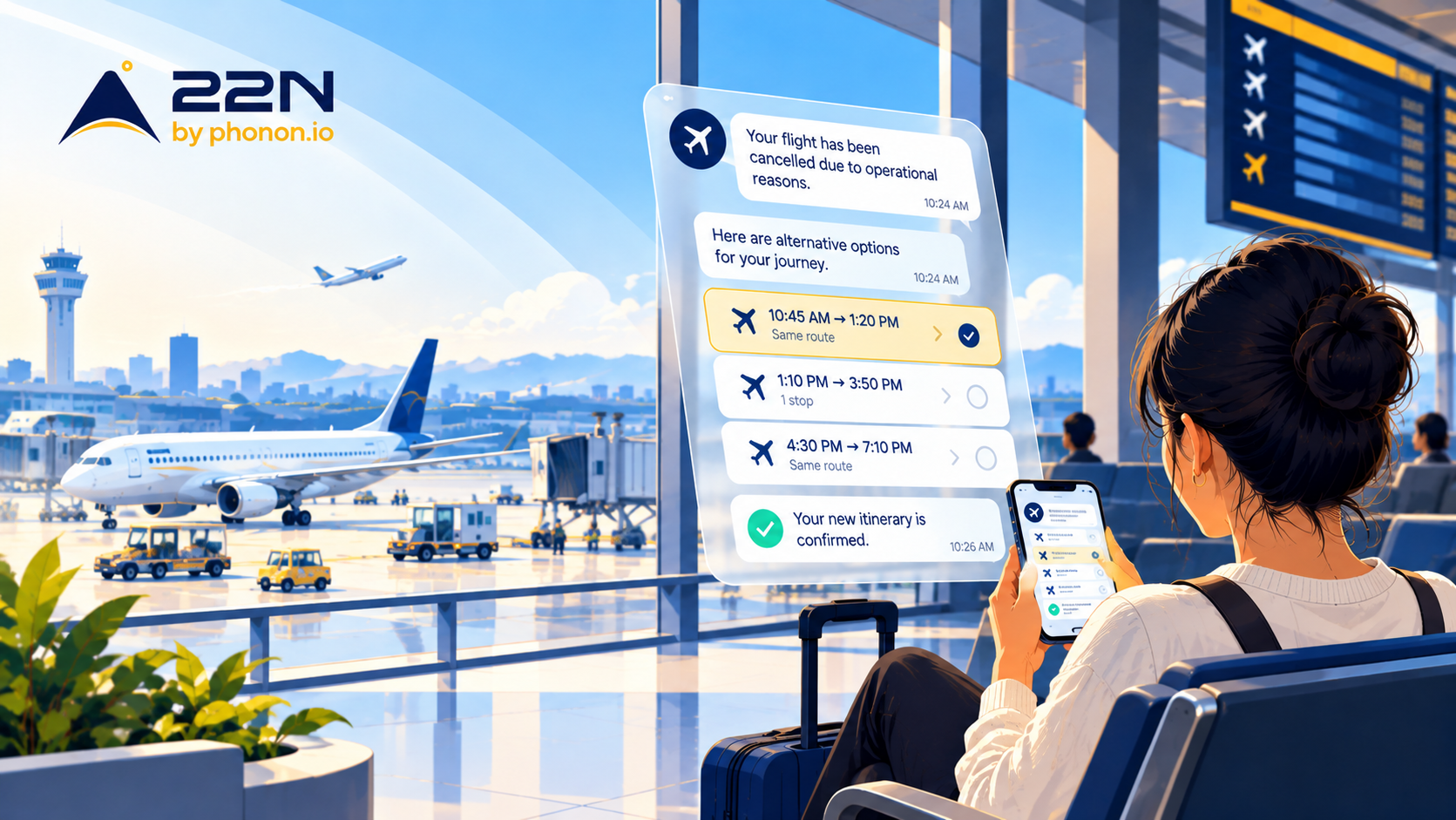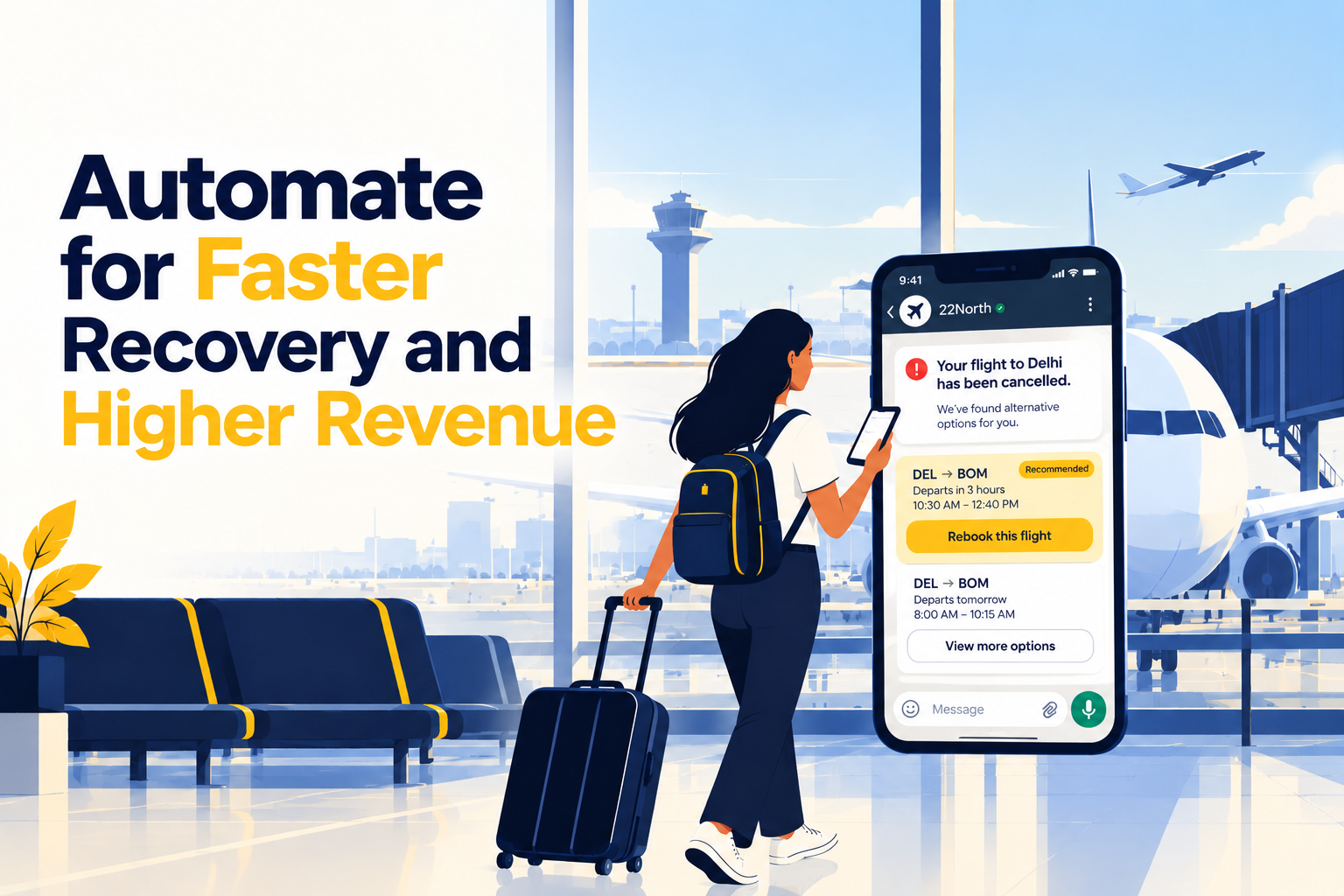
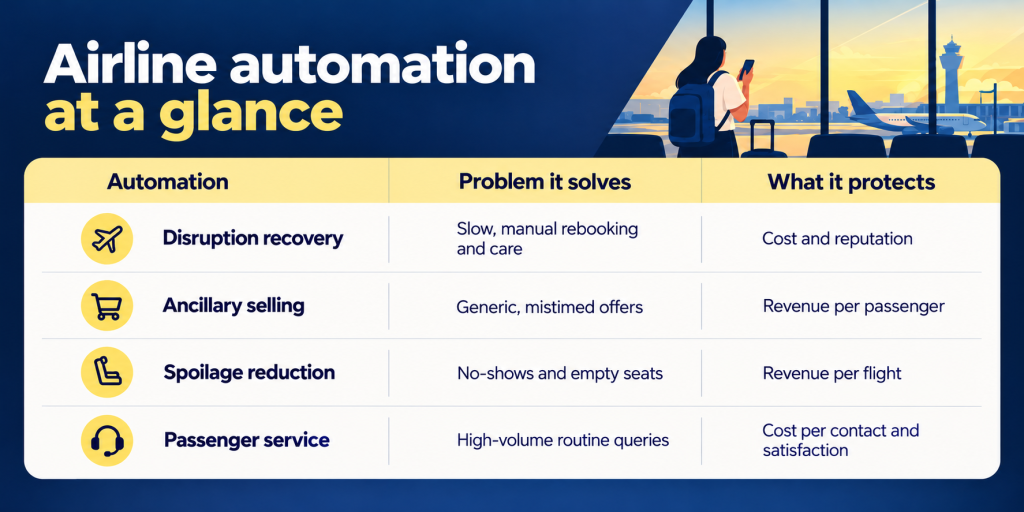
Automations for faster recovery and higher revenue deal with automating disruption recovery, ancillary selling, spoilage reduction and passenger service. With IATA forecasting net profit of just $4.50 per passenger in 2026, these are where airlines can protect margin.
Why does airline automation matter in 2026?
Airlines are carrying record numbers of passengers while making very little on each one. In June 2026, IATA halved its industry forecast to USD 23 billion in net profit, a 2% net margin. It expects net profit per departing passenger to fall from USD 9.1 in 2025 to USD 4.5 in 2026 (IATA Economics, June 2026).
Load factors are also at record highs, with the global passenger load factor reaching 83.6% in 2025 (IATA). Planes are full and margins are thin, so every manual process, missed upsell and unanswered passenger query costs money.
Here’s how you can address that.
1. Automating disruption recovery.
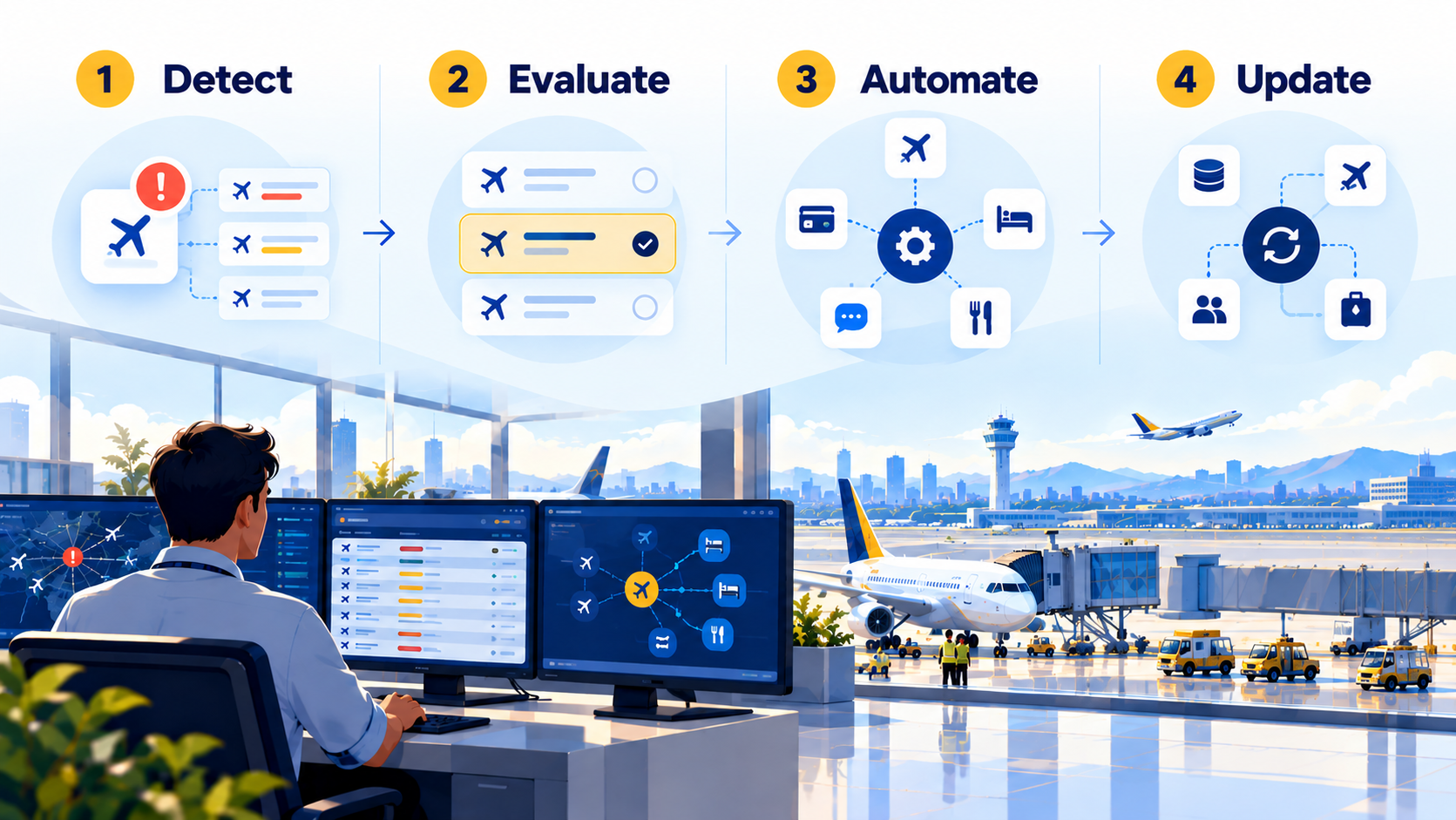
Automated disruption management rebooks passengers, issues refunds, and offers meals and hotels within minutes. That lowers servicing costs and takes pressure off agents and call centres.
Disruption is one of the most expensive problems in aviation. A T2RL study commissioned by Amadeus estimated that it costs airlines and their customers up to $60 billion a year, about 8% of worldwide airline revenue. The study is a decade old, so read it as a measure of scale rather than a current total.
The passenger side is documented more recently. An AirHelp survey found that 79% of respondents had a flight disrupted in the past 12 months. Of those, 73% incurred extra expenses, averaging €514 per person. Earlier AirHelp research found that proactively providing adequate information could raise customer satisfaction by 60%.
What to automate:
- Rebooking onto the next available flight
- Refunds and compensation workflows
- Meal vouchers and hotel accommodation
- Proactive passenger notifications
This is the challenge RecoverMax is built for. Passengers receive options on their phone immediately, and your teams handle the exceptions.
2. How can airlines increase ancillary revenue with automation?
Behaviour-based automation makes the right offer to the right passenger at the right moment, such as a baggage upgrade 24 hours before departure or a priority upgrade during a delay. That converts better than generic offers.
Ancillary revenue is now a core part of airline economics. IdeaWorksCompany reports it accounts for 15.7% of total airline revenue, up from 9.1% in 2016, with a record $157 billion projected for 2025, compared with $67.4 billion in 2016.
The upside is that ancillary revenue needs no new aircraft or routes. Automation matters because timing and relevance drive conversion, and a person can’t tailor offers for thousands of passengers at once. Implementing RevenueMax enables dynamic, contextual upselling throughout the journey.
3. How can automation help reduce spoilage?
With load factors around 84%, roughly one seat in six still flies empty. Not all of that is recoverable, but some of it is.
The US Government Accountability Office found that fewer than 1% of passengers are denied boarding. In 2018, about 43 per 100,000 boardings were voluntarily denied boardings, against about 1 per 100,000 involuntary (a review of seven major US airlines). Volunteer-first approaches work, but only when offers are timely and attractive.
What to automate:
- Early identification of probable no-shows.
- Voluntary re-accommodation offers (a meal coupon, a discount, a later flight)
- Messaging passengers on oversold flights before they reach the gate.
4. Automating passenger service.
Flight status, baggage, lost and found, and accessibility requests are predictable queries that can be handled across WhatsApp, SMS, email, push notifications and public warning systems. That means fewer calls, faster answers and lighter service teams.
Passengers rate airline care during disruption poorly. In an AirHelp survey, passengers scored 3.13 out of 10, and 82% said they weren’t informed of their rights. Clear, immediate communication is the cheapest fix.
22North’s InformMax handles these queries across channels, so agents spend their time on the cases that need a human.
Frequently asked questions
What is airline disruption management?
It is the process of recovering from cancellations, delays and diversions, including rebooking passengers, arranging care and communicating changes. Automation speeds up each step.
How much do flight disruptions cost airlines?
A T2RL/Amadeus study estimated up to $60 billion a year, about 8% of airline revenue. The figure dates from 2016.
What share of airline revenue comes from ancillaries?
IdeaWorksCompany reports 15.7%, up from 9.1% in 2016.
What is airline overbooking?
Selling more tickets than seats, because some passengers don’t show up. Done well, it fills seats that would otherwise be empty. Done badly, it leads to denied boardings.
What is the average airline profit per passenger?
IATA forecasts USD 4.5 net profit per departing passenger in 2026, down from USD 9.1 in 2025.
Do airline automations need a long implementation?
Each one automates a process teams already run manually, so they can be adopted one at a time.
Ready to see this on your network? [Connect with us on Whatsapp]
Sources: IATA Economics, Profits and Margins to Shrink in 2026 (June 2026); IATA 2025 passenger market data; T2RL/Amadeus, Shaping the Future of Airline Disruption Management (2016); AirHelp surveys (2023, 2026); IdeaWorksCompany Global Estimate (November 2025); US GAO-20-191.