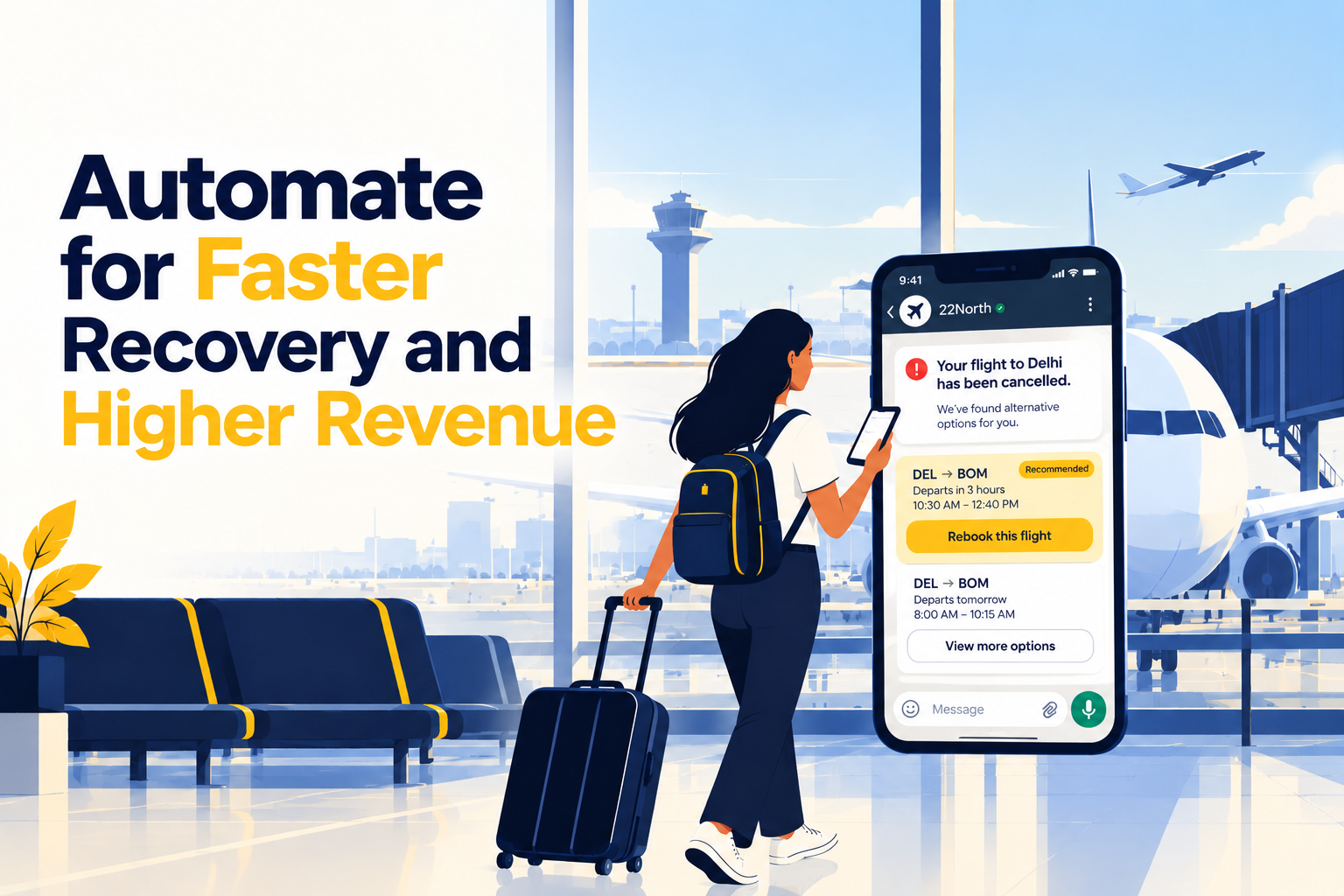
When a flight is cancelled, passengers need a clear answer to a practical question: “How will I get to my destination?”
An alert can explain what has changed. Recovery must go further: arrange an alternative journey, confirm the booking and give the passenger a workable route to assistance or another eligible choice.
For leaders evaluating airline disruption management software, the critical question is what happens after the passenger receives the message.
A useful platform should help the airline move from an operational event to a confirmed passenger outcome, while making unresolved cases visible to the people who can act. This guide explains what to look for, what to test in a demonstration and how to measure whether recovery is improving, when using airline disruption management software.
The short answer: Airline disruption management software should connect operational events, passenger context, recovery rules, available options, communications and fulfilment. Evaluate it on confirmed outcomes, exception handling and integration with your airline’s systems, alongside the speed and reach of its notifications.
What is airline disruption management software?
Airline disruption management software helps airlines respond to irregular operations, commonly called IROPS or IRROPS. These include delays, cancellations, diversions and missed connections.
The category covers several different jobs. Some systems focus on restoring aircraft and crew schedules. Others specialise in passenger communications, reaccommodation or arranging services such as hotels and transport. These capabilities can work together, but they should be evaluated separately.
- Operational recovery: How do we restore the flight programme?
- Passenger communications: Who needs to know what, and through which channel?
- Passenger reaccommodation: Which alternative journeys are available and appropriate?
- Passenger assistance: What support does this passenger need while waiting?
- Fulfilment and case tracking: Was the chosen outcome completed, and what remains unresolved?
Before comparing vendors, identify which part of this workflow your airline needs to improve. A strong communication capability and a strong reaccommodation capability solve different parts of the same passenger problem.
Start with the passenger’s whole journey
A flight-level disruption does not affect every passenger in the same way. A delay might be manageable for a passenger travelling directly to their destination. For another, it could make an onward connection impossible. A replacement itinerary may work for an individual traveller but create difficulties for a family booking.
The recovery workflow therefore needs enough context to distinguish between these situations. That context may include the itinerary, booking party, onward connections, assistance requirements, purchased services and the passenger’s previous choices.
Ask a prospective provider to demonstrate how that information changes the options a passenger receives. A generic message addressed to someone by name is only the beginning of personalisation.
Flight cancellation recovery with passenger choice
Consider the cancellation recovery workflow described by the 22North team. The airline rebooks affected passengers onto alternative flights according to their protection status and updates the recovery plan to reflect the new arrangements.
Passengers receive a proposed solution rather than having to start the search themselves. They can review their revised itinerary and, where another eligible option better suits their plans, choose a change.
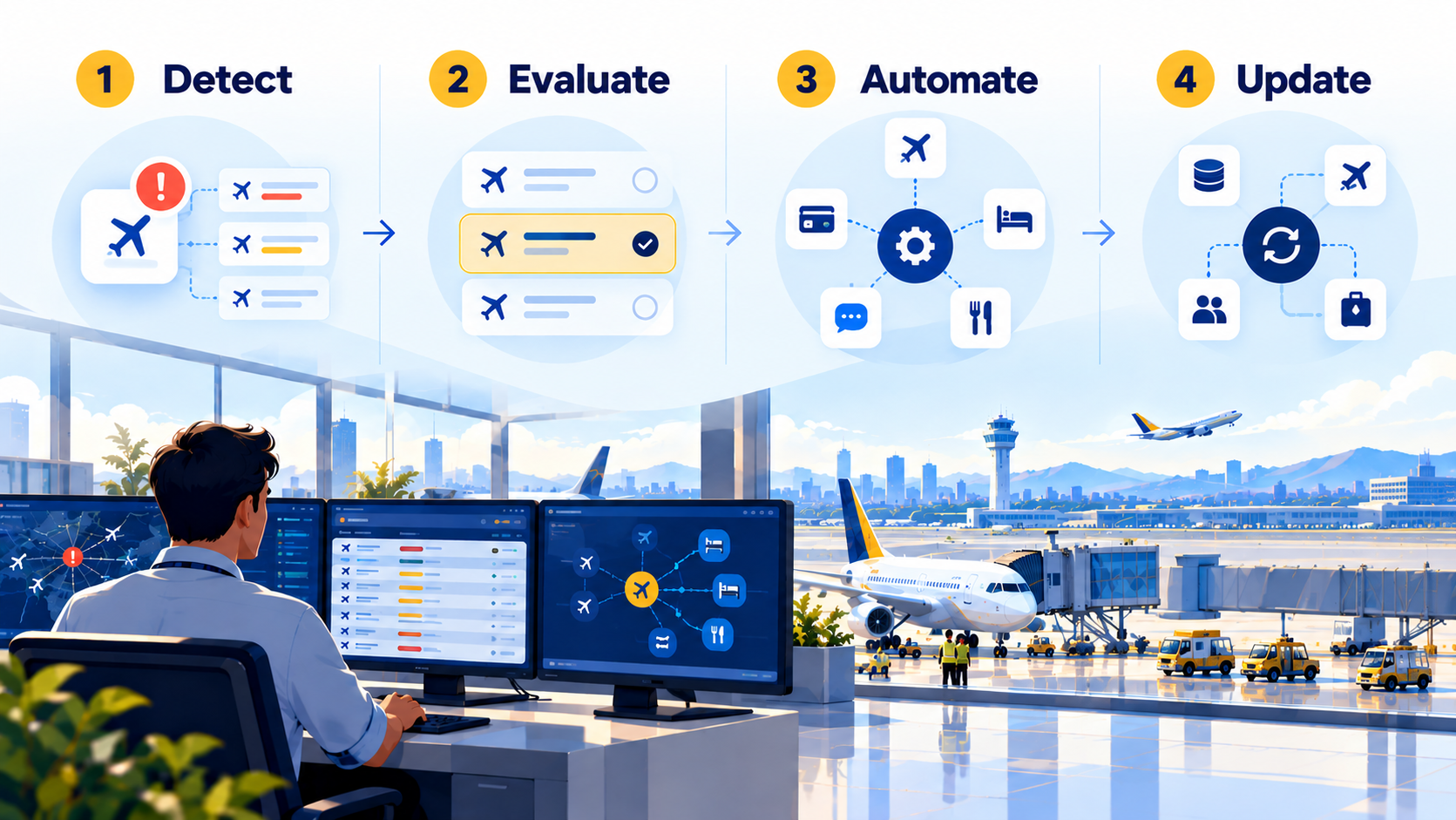
The process connects five steps:
- Identify affected passengers and their protection status. Establish which passengers already have arrangements in place and which require further action.
- Rebook passengers onto alternative flights. Apply the airline’s recovery rules and available inventory.
- Update the recovery plan. Record the revised arrangements and keep outstanding cases visible to the team.
- Communicate the new itinerary and available choices. Explain what has been arranged and how the passenger can select another eligible option.
- Confirm any passenger-selected change. Complete the booking update, reflect it in the recovery plan and send the passenger their confirmed itinerary.
A passenger may prefer a later departure, for example, even when the airline has arranged an earlier alternative. Offering that flexibility allows the recovery to accommodate individual needs within the airline’s rules and available capacity.
The key is keeping the passenger’s choice, the confirmed booking and the recovery plan aligned. Selecting an alternative is one step; the workflow is complete when the change is confirmed and all three reflect the same outcome.
For an airline evaluating disruption recovery software, this provides a useful demonstration test: can the platform handle both the initial protective rebooking and a subsequent passenger-requested change without losing track of the passenger’s current arrangements?
Seven tests for an airline passenger recovery platform
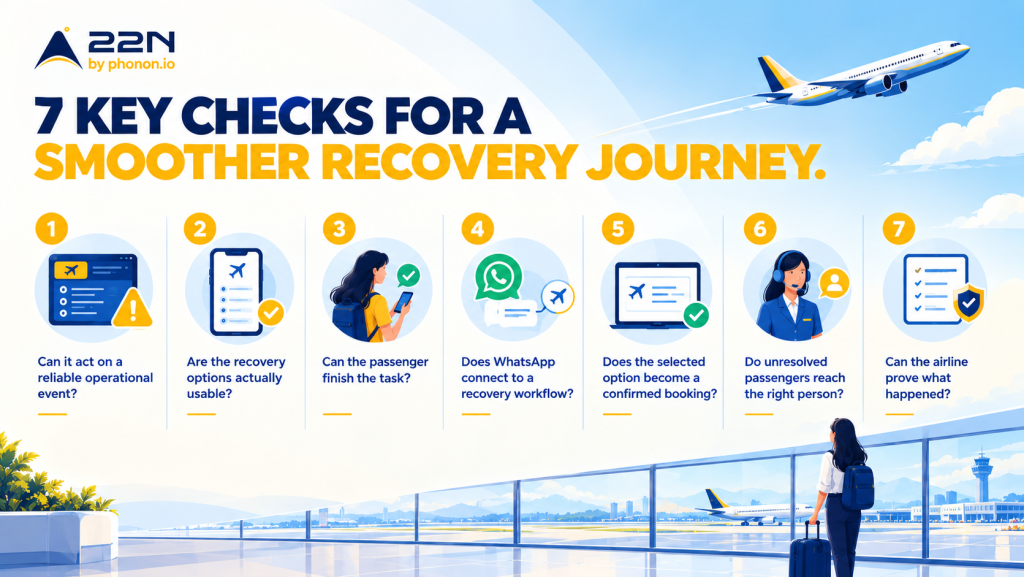
1. Can it act on a reliable operational event?
Recovery starts with knowing what has changed. Ask which system supplies the disruption event, how quickly it becomes available and how subsequent updates are handled. A revised departure time should not leave passengers looking at an obsolete instruction.
The demonstration should include a second change to the same flight. Watch what happens to passengers who have already received a message or started making a selection. The platform should maintain a clear record of which event triggered which action.
2. Are the recovery options actually usable?
An alternative flight is useful only if it is available, appropriate for the passenger and permitted under the airline’s rules. Ask how the platform checks inventory, connection feasibility, booking-party requirements and the authority to make a change. Establish which scenarios it can complete automatically and which require an agent.
Then test a difficult case: the last available seats disappear while the passenger is reviewing their options. Does the platform refresh availability and explain the change? Does it offer another path? Or does the passenger reach a dead end?
3. Can the passenger finish the task?
Self-service should be assessed through to completion. A passenger may need to accept a replacement itinerary, select another eligible option or request help. The journey should explain the choices clearly and provide confirmation of what has happened.
Test it on a phone, with a realistic booking, from the first message to the final outcome. Count repeated information requests, unnecessary logins and points where the passenger must switch channels.
IATA’s disruption-management material identifies timely communication, self-service and context-aware experiences as passenger needs. Those principles are most useful when they shape the whole recovery journey.
4. Does WhatsApp connect to a recovery workflow?
WhatsApp can provide a conversational entry point for passenger communication and self-service. Its usefulness depends on what the connected systems allow the passenger to accomplish.
When evaluating an airline WhatsApp bot, ask:
- Can it retrieve the relevant disruption and booking context?
- Can it present options approved by the airline?
- Can it securely initiate and confirm an authorised action?
- Can it transfer the conversation and its history to an agent?
Also check the fallback journey. Passengers who cannot receive or use WhatsApp still need a workable route to information and assistance. The evaluation should follow the passenger across channels, including what happens when they start in one channel and seek help in another.
5. Does the selected option become a confirmed booking?
This is one of the most important integration tests. Selecting a replacement flight, updating a reservation and completing any required ticketing steps are distinct events. A passenger-facing confirmation should accurately reflect the state of the underlying transaction.
Ask the provider to show the relevant reservation-system update and how it deals with partial failures. What happens if a request times out? Can a retry create a duplicate action? Who sees the exception? What does the passenger see while the result is uncertain? A recovery workflow needs a defined route through these situations.
6. Do unresolved passengers reach the right person?
Some cases require judgement, assistance or access beyond the automated workflow. The platform should make those cases visible, explain why they need attention and route them to an appropriate team. Agents should receive the passenger’s context, previous messages and attempted actions.
Ask to see the unresolved-case queue during the demonstration. A healthy self-service rate is useful. So is knowing exactly who still needs help.
7. Can the airline prove what happened?
An audit trail should connect the disruption event, the options offered, the passenger’s response and the final outcome. This gives operations and customer service teams a shared basis for answering questions. It also helps distinguish between a communication failure, a booking-system failure and a passenger who has not yet responded.
Request a sample case history. It should be understandable to the people who will use it during a difficult operating day.
Give every vendor the same disruption scenario
A consistent demonstration brief makes comparisons more meaningful. Use this illustrative scenario:
A flight carrying 180 passengers is cancelled. The passenger list includes connecting travellers, family bookings, passengers requiring assistance and bookings without a usable mobile number. Alternative flights have limited inventory. Passengers are rebooked according to their protection status, and some request a different eligible flight. During recovery, availability changes and one booking-system request times out.
Ask each vendor to demonstrate the complete journey:
- Identify affected passengers, their protection status and their needs.
- Generate eligible recovery options and arrange protective rebooking.
- Update the recovery plan and communicate through available channels.
- Capture a passenger’s request for a different eligible option.
- Complete and verify the underlying transaction, then update the recovery plan.
- Route exceptions to an agent with context.
- Report confirmed outcomes and unresolved cases.
Record whether each capability is available today, requires configuration, depends on another provider or remains planned. This exercise gives procurement, operations and technology teams a common basis for discussion.
Measure recovery at five points
For a pilot, keep the executive dashboard of the airline disruption management software focused:
- Time to first usable option: Time from the airline’s confirmed disruption event to an eligible recovery option being made available to the passenger. Track the median and 90th percentile.
- Confirmed self-service completion: Eligible passenger cases completed without agent intervention, divided by all cases eligible for the pilot workflow.
- Unresolved cases at agreed checkpoints: Passenger cases still awaiting a confirmed outcome at defined intervals after the disruption.
- Assisted contacts per 100 disrupted passengers: Disruption-related calls, chats and service-desk contacts relative to the affected passenger population.
- Recovery servicing cost per disrupted passenger: The defined cost of handling recovery, divided by affected passengers. Keep included costs consistent between periods.
Define whether a “case” represents a passenger or a booking, and use that definition consistently. Compare similar disruptions. A weather event affecting an entire hub is not directly comparable with an isolated cancellation on a route with spare capacity.
Review message delivery and engagement as supporting measures. They help explain the results, but the main dashboard should show whether passengers reached a confirmed outcome and how much effort that required.
Where AI can help in airline disruption management software
AI can support disruption recovery by helping interpret passenger requests, summarise conversations and prioritise cases for attention.
Actions that change a passenger’s journey need clear operating boundaries. Availability should come from authoritative systems. Recovery options should follow approved rules. Transactions should be verified, with a defined escalation path when the system cannot complete them.
When a vendor describes its platform as AI-powered, ask it to identify the specific decision or task that AI performs, the information it relies on and the controls around its actions. That makes the claim testable.
How 22North approaches passenger recovery
22North is a Passenger Operations Platform for airlines. Within its suite, airline disruption management software RecoverMax focuses on disruption recovery and passenger-led self-service. ImpactMax passenger communications platform connects operational events with passenger notifications across channels including WhatsApp, SMS and email.
For an airline evaluating these capabilities, the starting point should be a specific operating scenario: the event that triggers recovery, the passengers affected, the choices they can make and the systems that must confirm the result. That creates a practical basis for defining the integration scope and measuring the outcome.
Planning a disruption recovery project?
Bring one real disruption scenario to a conversation with 22North. We can discuss the passenger journey, system dependencies and success measures relevant to your airline.
Frequently asked questions
What is the difference between IROPS communication and passenger recovery?
IROPS communication informs passengers about a disruption and their next steps. Passenger recovery includes arranging and confirming an appropriate outcome, such as a replacement journey, and managing cases that need additional assistance.
Can an airline WhatsApp bot handle flight rebooking?
It can support rebooking when it is connected to the required airline systems and authorised workflows. The scope depends on booking access, available inventory, airline rules and the ability to complete and verify the transaction.
Can passengers choose another flight after protective rebooking?
A recovery workflow can allow passengers to select another eligible flight after an initial rebooking. The available choices depend on the airline’s rules and inventory. Once a change is confirmed, both the booking and the recovery plan should reflect it.
Does passenger recovery software replace the airline’s reservation system?
It can work alongside the existing reservation system. Buyers should establish which system owns each action, what integration access is required and where the final booking and ticketing status is confirmed.
What should an airline measure in a disruption recovery pilot?
Start with time to a usable option, confirmed self-service completion, unresolved cases, assisted-contact demand and recovery servicing cost. Define the eligible passenger group and compare outcomes against a suitable baseline.
Sources
[1] IATA: Disruption Management — Service Excellence or Fire Fighting? Referenced for passenger needs around communication, self-service and context.
[2] 22North Passenger Operations Platform. Referenced for the published positioning of RecoverMax and ImpactMax.
The cancellation recovery workflow reflects the example supplied by the 22North team. The 180-passenger vendor demonstration is illustrative, not a reported customer case study.