Airlines are increasingly exploring artificial intelligence (AI) to improve passenger experiences, simplify operations and automate everyday tasks. But for AI to be truly useful in aviation, it needs access to the right information and systems.
This is where Model Context Protocol (MCP) comes in.
Introduced by Anthropic in 2024, MCP provides a standardised way for AI applications to connect with external tools, data sources and services. For airlines, it offers a potential way to connect AI assistants with the systems that power bookings, flight information, passenger services and operational workflows.
What Is MCP?
Model Context Protocol (MCP) is a standard that helps AI applications connect with external systems and use their tools and data.
Without MCP, developers may need to build separate integrations for different AI applications and backend systems. MCP provides a common way for these systems to communicate.
Think of it as a bridge between an AI assistant and the tools it needs to complete a task.
An MCP setup typically involves three components:
-
MCP host: The AI application, such as a passenger assistant.
-
MCP client: The component that communicates with an MCP server.
-
MCP server: The component that makes specific tools and information available to the AI application.
Together, these components allow an AI application to request information or use authorised tools without requiring every system to be connected in a completely different way.
How Does MCP Work in Aviation?
Imagine a passenger asks an airline’s AI assistant:
“What flights are available from Delhi to Dubai on 25 December?”
Here’s how an MCP-enabled workflow could work:
-
The passenger asks a question. The AI assistant receives the flight search request.
-
The assistant requests information. It identifies the appropriate flight-search tool.
-
MCP connects the request. The MCP client communicates with the relevant MCP server.
-
The airline system provides data. The server uses its configured integration to retrieve available flight information.
-
The assistant presents the results. The passenger receives relevant options based on the information returned.
The same approach could support other tasks, such as retrieving flight status, accessing booking information or initiating an approved passenger service workflow.
Importantly, MCP does not provide flight data itself. It provides a standardised way for AI applications to access tools that retrieve or act on that data.
Why Does MCP Matter for Aviation?
Airlines operate across a complex network of booking systems, airport systems, communication platforms and operational tools. Connecting these systems efficiently is essential, particularly when information needs to be accurate and timely.
Aviation-specific MCP integrations could help in several ways.
1. Connect Different Airline Systems
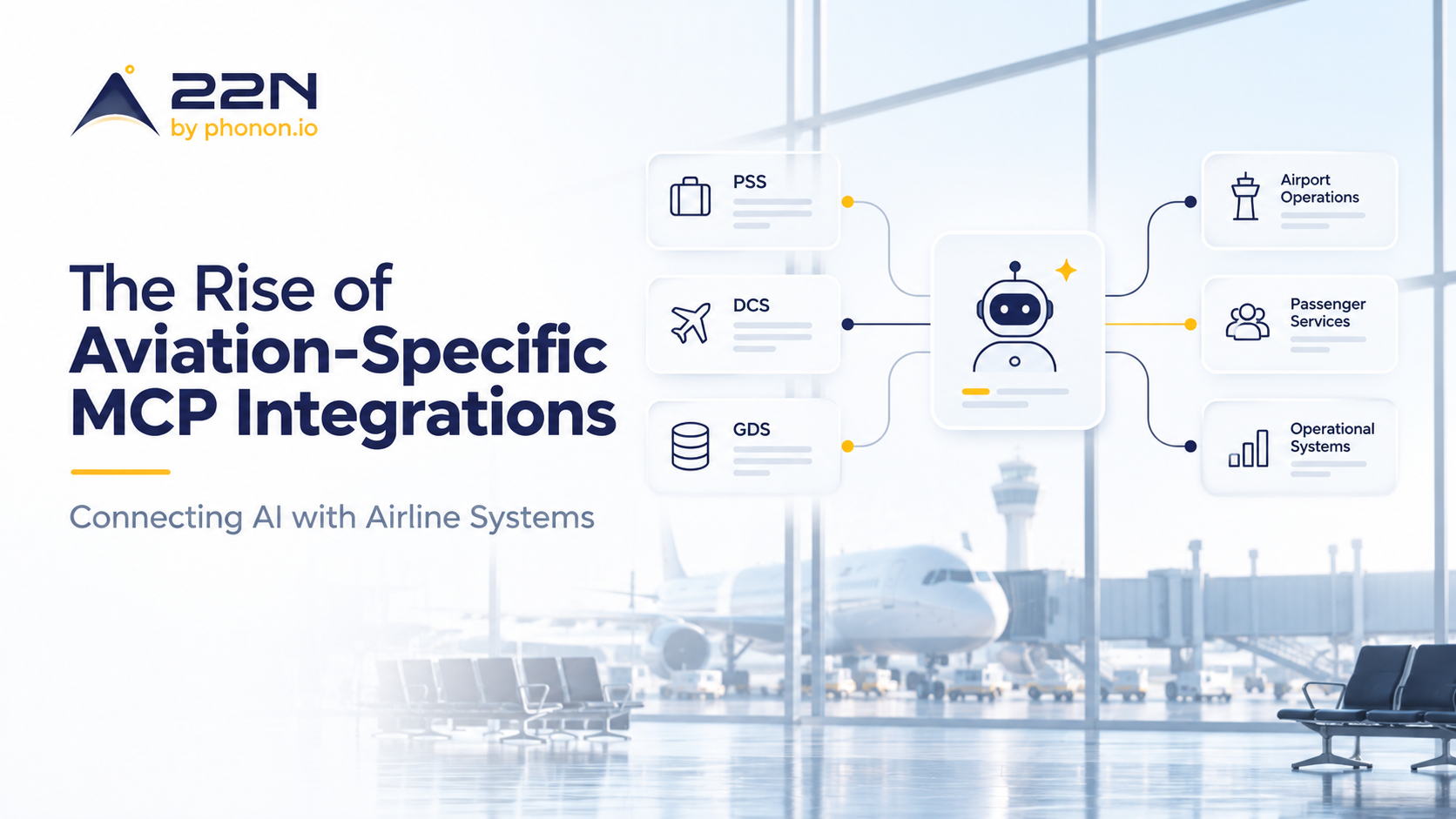
Airlines use systems such as Passenger Service Systems (PSS), Departure Control Systems (DCS) and Global Distribution Systems (GDS).
MCP can provide a consistent interface to selected functions within these systems, making them easier for supported AI applications to access.
2. Access Up-to-Date Information
AI models do not automatically know the latest flight status, booking details or seat availability.
Through authorised integrations, an AI application can request current information when needed instead of relying solely on its training data.
3. Improve Passenger Experiences
MCP-enabled tools could support passenger journeys from booking and pre-travel assistance to disruption recovery and post-travel communication.
For example, an AI assistant could retrieve flight information or access an approved service workflow through connected tools.
4. Simplify AI Integrations
A common protocol can reduce the need to develop a different connection pattern for every AI application and backend service.
The actual effort still depends on existing APIs, system compatibility and the complexity of each workflow.
5. Enable More Automation
When connected to the right tools, AI applications can do more than answer questions. They may also initiate supported actions, such as generating documents, creating QR codes or managing communication workflows.
These capabilities depend on the tools and permissions made available to the application.
What Are the Risks of MCP in Aviation?
While MCP creates new possibilities, airlines must approach implementation carefully. Aviation systems handle sensitive passenger information and support time-critical operations.
Security is a key consideration. Poorly configured integrations, excessive permissions, malicious tool descriptions and prompt injection can create risks. Appropriate authentication, access controls, monitoring and validation are essential.
Data quality matters, too. MCP cannot guarantee that information is accurate or current. That depends on the connected systems and the quality of their integrations.
Sensitive actions need safeguards. Tasks such as booking changes, refunds and passenger re-accommodation may require additional validation, business rules or human approval.
Finally, MCP does not eliminate integration complexity. Airlines still need to connect their systems, test workflows and maintain their underlying integrations.
The goal is to make AI integrations more consistent without compromising operational reliability or control.
How Is 22North Building an Aviation-Specific MCP Layer?
22North by Phonon is developing an aviation-focused MCP layer to simplify how AI applications connect with airline capabilities and operational workflows.
The aim is to make selected tools and services accessible through a consistent interface, helping airline partners build connected AI-enabled experiences.
The approach includes support for capabilities such as:
-
Communication management: Access tools for managing passenger communications across supported channels.
-
Document and QR-code generation: Generate useful passenger-facing assets through connected tools.
-
Workflow automation: Configure passenger journeys and notifications using a low-code flow designer.
-
Information access: Retrieve current information from connected systems where authorised integrations are available.
-
Integration management: Provide a more consistent way to expose supported tools and services to AI applications.
Combined with 22North’s low-code flow designer, this approach can help teams configure, manage and track automated passenger journeys and notifications.
The broader vision is to connect AI capabilities with the systems and workflows airlines already rely on, making integration more practical and automation easier to manage.
What Does the Future of MCP Look Like in Aviation?
As airlines explore AI for passenger servicing and operational automation, connecting AI applications to reliable data and authorised tools will become increasingly important.
MCP offers a standardised way to make these connections. Aviation-specific implementations can build on that foundation to address the industry’s unique requirements, including complex system integrations, time-sensitive information and operational safeguards.
The real opportunity lies not simply in adopting a new protocol, but in using it to make airline workflows more connected, efficient and adaptable.
22North is working towards this future with an aviation-focused MCP layer, connected tools and configurable automation.
Explore AI-Enabled Aviation Automation with 22North
Want to explore how MCP integrations could support your airline’s passenger operations?
Connect with our Travel Automation Experts.
Email: connect@22north.io
Website: www.22north.io
22North by Phonon — connecting airline systems, AI-enabled workflows and passenger operations.