Airline contact centre automation is transforming how airlines manage passenger enquiries, reduce repetitive work and deliver faster customer service. Traditional airline contact centres often rely on phone queues, manual processes and reactive support. Today, airlines can use automation, omnichannel communication and connected systems to prevent avoidable enquiries and resolve passenger issues more efficiently.
The future of airline customer service is not simply about handling more calls. It is about providing timely information, maintaining context across channels and delivering consistent, personalised passenger experiences throughout the travel journey.
With 22North by Phonon, airlines can explore connected communication and automation workflows designed around the operational needs of aviation.
1. Airline Contact Centre Automation Enables Proactive Passenger Communication
Traditional contact centres often wait for passengers to report a problem. However, flight delays, cancellations and gate changes can trigger large volumes of enquiries that timely communication could help reduce.
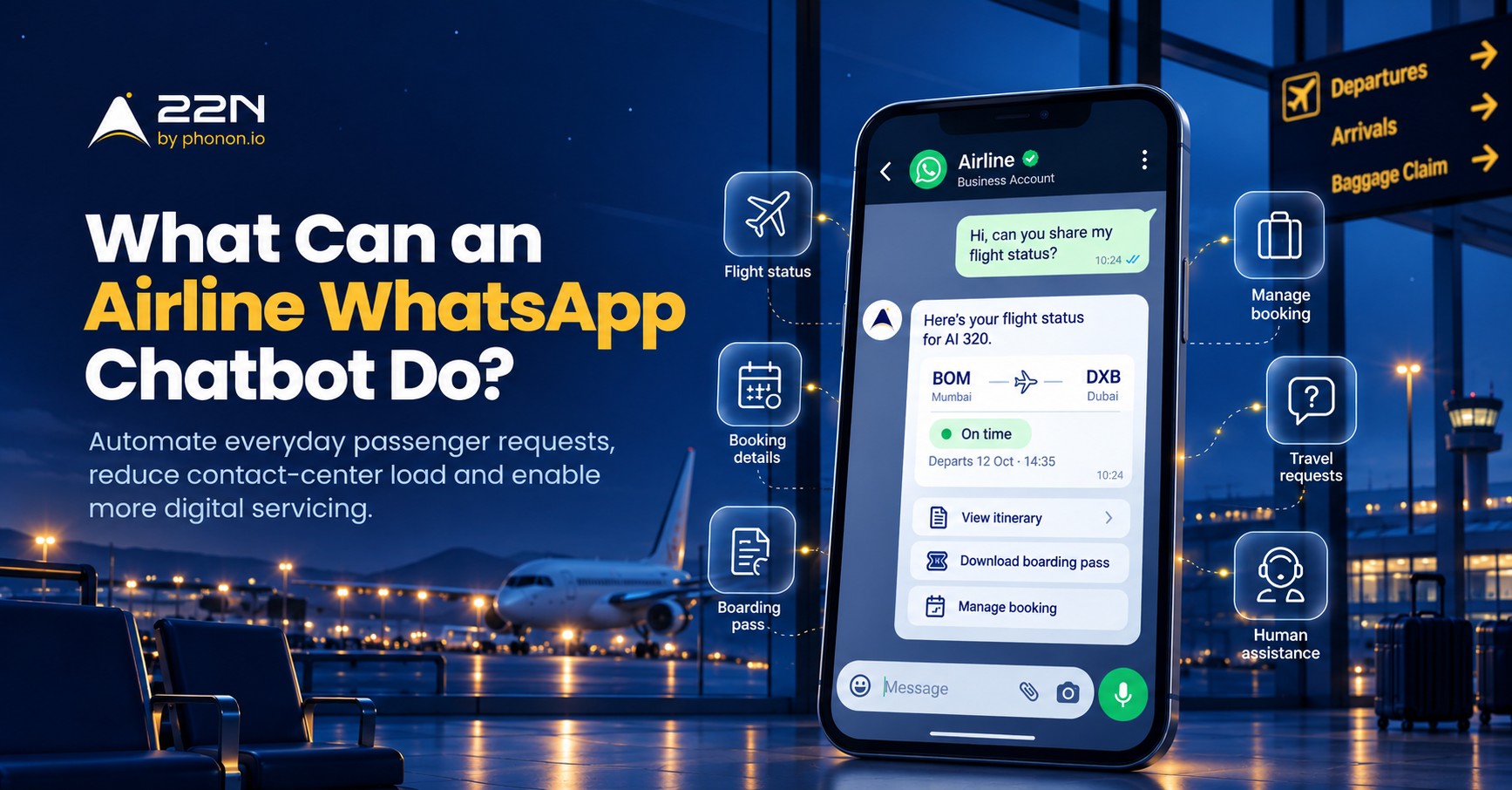
Airline contact centre automation enables airlines to notify passengers before they need to contact customer support.
Automated workflows can help airlines:
- Send flight status, delay and gate-change notifications.
- Share pre-departure reminders and travel information.
- Provide links to self-service options.
- Communicate disruption-related updates.
- Guide passengers towards available next steps.
By connecting operational events with passenger communication, airlines can reduce avoidable enquiries and help travellers make informed decisions.
2. Omnichannel Airline Customer Service Without Repeated Questions
Passengers may begin an enquiry on WhatsApp, continue through web chat and later speak with a contact centre agent. Without connected systems, they may have to explain their situation repeatedly.
Effective airline contact centre automation should work alongside omnichannel airline customer service, allowing agents to access relevant conversation history and passenger context across supported channels.
An integrated airline contact centre software solution can help teams:
- Manage interactions across supported messaging and voice channels.
- Access previous conversations and relevant information.
- Maintain continuity when cases move between agents.
- Coordinate responses through a shared agent workspace.
- Deliver a consistent passenger experience.
This approach can reduce repetitive questioning, improve agent efficiency and help passengers receive more coherent support.
3. Airline Customer Service Automation for Repetitive Tasks
Not every passenger enquiry requires direct agent intervention. Guided self-service and predefined workflows can manage predictable, high-volume requests.
Examples include:
- Retrieving flight status information.
- Sharing boarding passes and travel documents.
- Providing baggage updates when connected data is available.
- Answering common travel questions.
- Guiding passengers through supported service workflows.
Airline customer service automation allows agents to focus on complex cases that require judgement, empathy or additional coordination.
Clear escalation paths remain essential. When an enquiry becomes complicated, the passenger should be able to reach an appropriate agent with the relevant conversation context available.
The goal is to make human support more effective, not to remove the human element from airline customer service.
4. Personalised Airline Passenger Experiences Through Context
Passengers expect airlines to understand their journey rather than treat every enquiry as an isolated interaction.
Relevant context may include booking details, flight status, previous interactions, passenger preferences and loyalty information, where available and appropriately authorised.
An airline passenger communication platform can use this information to support more relevant responses and workflows.
For example, during a flight disruption, a passenger may need updated flight information, available recovery options or guidance on the next steps. Providing relevant information at the right time can reduce confusion.
Personalisation may also support relevant ancillary offers when appropriate to the passenger’s journey.
5. Resilient and Compliant Airline Communication Systems
Airlines operate across multiple regions, communication channels and regulatory environments. Contact centres must be prepared for sudden increases in enquiries while protecting passenger information.
A reliable airline communication platform should support:
- Configurable channel routing and fallback workflows.
- Secure handling of passenger information.
- Appropriate consent and communication preferences.
- Access controls and communication records.
- Monitoring of message delivery and system performance.
These capabilities can help airlines prepare for operational peaks and maintain visibility into communication activities. Actual resilience depends on the complete system, including infrastructure, integrations and communication providers.
6. Use Contact Centre Analytics to Improve Airline Customer Experience
Airline contact centres generate valuable information about passenger needs, recurring problems and service performance.
Analysing this data can help airlines identify opportunities to improve operations and the overall airline customer experience.
Useful metrics include:
- Average response and resolution times.
- Contact volumes by enquiry type.
- First-contact resolution rates.
- Channel usage and message delivery outcomes.
- Repeat enquiries and escalation rates.
- Passenger satisfaction and feedback.
For example, if flight delays consistently generate calls about rebooking, airlines can assess whether proactive notifications or clearer self-service workflows could resolve some enquiries before they reach an agent.
The objective is to use operational insights to improve workflows continuously, rather than relying on dashboards alone.
7. Flexible Airline Contact Centre Software and Integrations
Airline technology ecosystems often include Passenger Service Systems (PSS), Departure Control Systems (DCS), reservation platforms, customer databases and communication providers.
Flexible APIs, modular capabilities and low-code workflow tools can help airlines introduce new services and automate processes without rebuilding their entire technology environment.
Potential applications include:
- Connecting messaging channels with airline operational data.
- Automating passenger notification workflows.
- Integrating customer service tools with booking information.
- Supporting additional self-service journeys.
- Extending communication workflows to new use cases.
These capabilities help airlines adapt their contact centre operations as passenger expectations and business priorities change.
8. Airline Conversational AI and Human-Agent Collaboration
Airline conversational AI and guided automation can support routine enquiries, while human agents focus on situations requiring judgement, empathy or individual attention.
Depending on the solution, automated tools can help retrieve information, guide passengers through predefined processes and support agents with relevant context.
For disruption-related enquiries, this combination can help airlines provide faster access to information while preserving human assistance for complex cases.
Successful airline service automation balances efficiency with the quality of the passenger interaction. The objective is not simply to process enquiries faster, but to help passengers reach useful and appropriate resolutions.
How 22North ConverseMax Supports Airline Contact Centre Automation
22North by Phonon offers ConverseMax, an omnichannel unified inbox designed to help airlines manage passenger interactions and streamline customer service workflows.
ConverseMax supports a connected approach to airline passenger servicing through capabilities such as:
- Omnichannel communication: Manage passenger interactions across supported channels.
- Conversation continuity: Access relevant interaction context to support smoother service.
- Workflow automation: Reduce repetitive work through configurable processes.
- Agent support: Help service teams manage, route and respond to passenger enquiries.
- Connected operations: Support integration with relevant airline systems and workflows.
For airlines evaluating airline contact centre software, the important consideration is how effectively a solution connects passenger communication, operational information and day-to-day service processes.
Explore the 22North ConverseMax platform to learn more.
The Future of Airline Contact Centres Is Proactive and Connected
Airline contact centre automation can help airlines reduce avoidable enquiries, streamline repetitive tasks and support more consistent passenger service.
By combining proactive communication, omnichannel continuity, connected integrations and human-agent collaboration, airlines can work towards more efficient servicing and better passenger experiences.
The opportunity extends beyond cost reduction. A well-designed contact centre can support disruption recovery, strengthen passenger relationships and create opportunities for relevant engagement throughout the travel journey.
As airlines modernise their customer service operations, automation and connected communication will play an increasingly important role.
Ready to Modernise Your Airline Contact Centre?
Discover how 22North can help your airline improve passenger communication, streamline service workflows and support connected customer experiences.
Email: connect@22north.io
Website: 22north.io
22North — connecting passenger communications, automation and airline operations.
Frequently Asked Questions
What is airline contact centre automation?
Airline contact centre automation uses technology and predefined workflows to manage routine passenger enquiries, trigger timely communications and help agents resolve issues more efficiently.
How does omnichannel airline customer service work?
Omnichannel airline customer service connects supported communication channels and helps preserve relevant passenger context as interactions move between channels or agents.
How can airlines improve customer service efficiency?
Airlines can improve service efficiency through proactive notifications, guided self-service, connected operational data, workflow automation and clear escalation to human agents.
What is airline contact centre software?
Airline contact centre software helps service teams manage passenger interactions, coordinate communication channels and support customer service workflows. Capabilities vary by provider and integration.