Customer service leaders are under increasing pressure to improve customer experience, reduce operating costs and scale support without continuously increasing headcount. Yet, when customer conversations are fragmented across channels, routine requests depend on manual intervention and customers repeatedly have to explain their problems, delivering efficient service becomes difficult.
The result is familiar: higher cost-to-serve, repeat contacts, longer handling times and inconsistent customer experiences.
Conversational AI for customer service helps organisations move beyond disconnected chatbots and channels towards connected service journeys that resolve customer requests more efficiently.
By bringing together omni-channel messaging, voice AI, customer context and workflow automation, businesses can reduce avoidable contact, improve service outcomes and make better use of their support teams.
That is the thinking behind ConverseMax by 22North.
1. Move Beyond Chatbots to Connected Customer Service
A traditional chatbot may answer a question. A connected conversational AI platform should help the customer get something done.
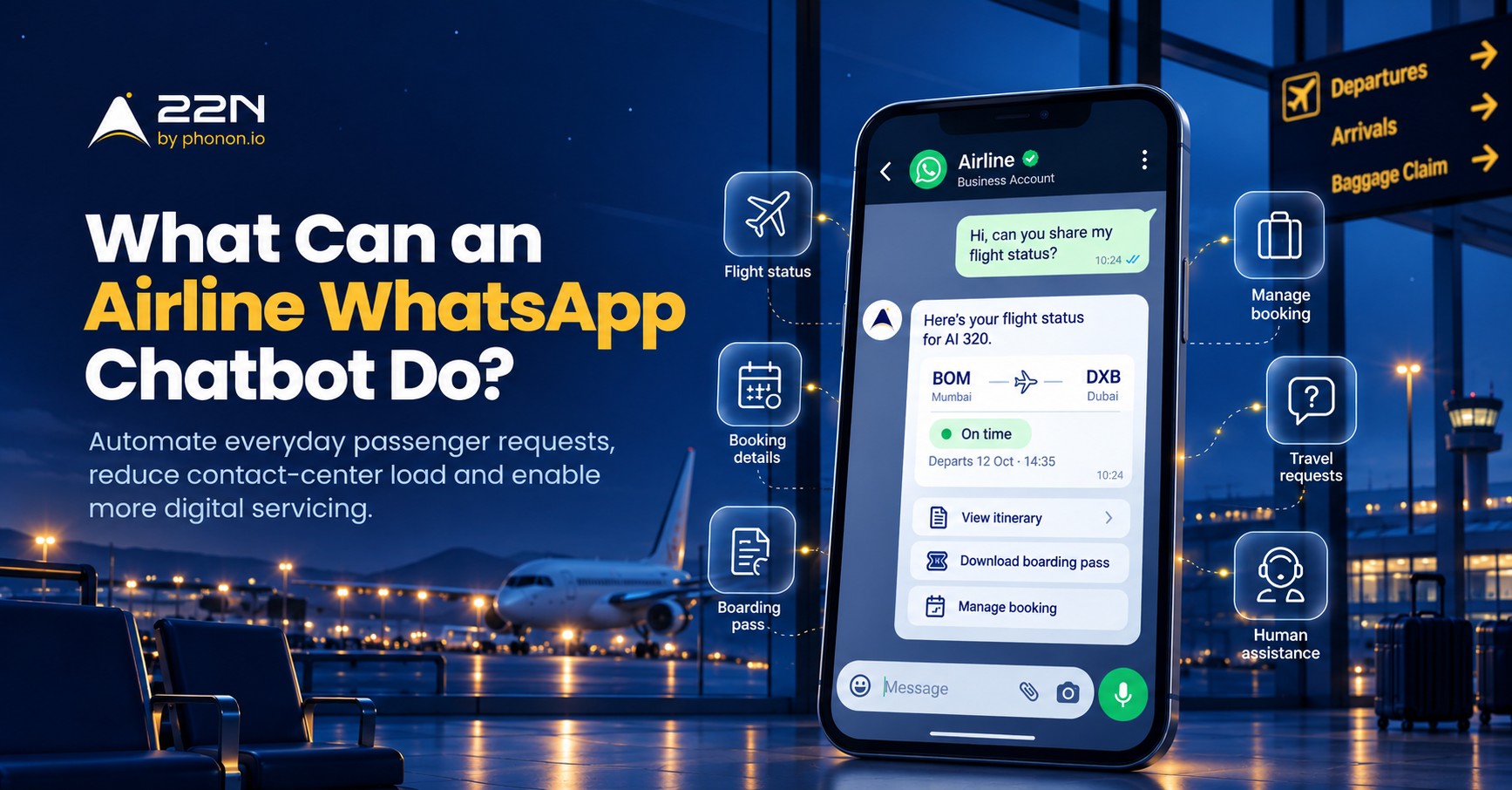
For an airline passenger, that could mean:
- Checking flight status and retrieving booking details
- Managing flight disruptions and exploring rebooking options
- Checking baggage information
- Receiving a boarding pass
- Requesting a refund
- Changing a booking
- Connecting with a human agent when assistance is needed
The distinction is important. Providing information is only one part of customer service. The real value comes from helping customers progress towards a resolution.
With conversational AI, customer interactions can become part of a structured service journey, connecting customer intent with relevant information, business workflows and the next appropriate action.
The objective is simple: move every eligible conversation closer to resolution, not just provide another answer.
2. Turn Customer Questions into Resolutions
Consider an airline passenger who messages customer support: “I want to change my flight.”
A basic chatbot might return a link to the airline’s help page or ask the passenger to contact another department. A connected conversational experience can take the interaction further. Depending on available integrations and business rules, it can retrieve relevant booking context, understand the passenger’s request, present eligible options and guide the passenger through the appropriate next steps.
The same principle applies to refunds, baggage enquiries, disruption support and other service journeys.
When conversational AI is connected to operational workflows, businesses can work towards:
- Fewer repeat contacts
- Faster request resolution
- Lower manual servicing effort
- Improved First Contact Resolution (FCR)
- Reduced pressure on customer service teams
The goal is not simply to automate replies. It is to reduce the effort required to complete a service task.
3. Extend Customer Service to Conversational Voice AI
Customers should not always have to navigate complex IVR menus or wait for an agent before the organisation understands what they need. Conversational Voice AI allows customers to describe their requirements naturally and move towards the appropriate service path.
Consider a hotel guest calling and asking: “Can I get a late checkout tomorrow?”
Instead of merely explaining the hotel’s checkout policy, a connected voice experience could use reservation context, check relevant availability and guide the guest towards the appropriate next step, subject to the hotel’s rules and system integrations.
The same approach can support:
- Reservation enquiries
- Early check-in and late checkout requests
- Housekeeping requests
- Restaurant bookings
- Airport transfer enquiries
- Hotel information and guest assistance
Where human judgement or approval is required, the interaction can be transferred to the relevant employee with the available context preserved. This helps address a common source of service frustration: having to repeat information when switching channels or speaking to a different agent. When implemented effectively, conversational voice AI can complement existing service teams while helping customers access assistance more naturally.
4. Create Continuous Conversations Across Channels
Customers do not think in terms of communication channels. They think about the problem they are trying to solve. A passenger might begin a conversation on WhatsApp, move to voice and later speak to a customer service agent. Ideally, these interactions should feel like one connected service journey rather than three separate conversations.
Omni-channel customer service connects interactions across channels while maintaining the relevant customer and conversation context.
This can help organisations reduce repetition, improve agent handoffs and deliver more consistent experiences across digital and voice touch points. A connected service model can also help teams monitor performance through metrics such as:
- Repeat Contact Rate: How frequently customers contact the organisation again about the same issue.
- First Contact Resolution: How often a customer request is resolved during the initial interaction.
- Average Handling Time: How long an interaction takes to handle.
- Escalation Rate: How frequently conversations require additional intervention.
- Customer Satisfaction (CSAT): How customers rate their service experience.
These metrics help businesses evaluate whether connecting conversations is translating into measurable service improvements.
5. Use Customer Context to Make Better Service Decisions
The latest customer message rarely tells the whole story. A passenger asking about delayed baggage may be making their first enquiry. Another passenger may have already contacted the airline several times without receiving a satisfactory resolution. Treating both interactions identically can lead to unnecessary frustration and inefficient use of service resources.
Conversational AI can help interpret signals such as customer intent, urgency, sentiment and previous interaction history. Subject to the data available and the organisation’s policies, these signals can help prioritise conversations, route requests and identify when additional attention is needed.
For example, a routine flight-status enquiry may be suitable for automated handling, while a repeated unresolved baggage complaint may require escalation to an experienced agent. Better customer context also helps agents spend less time reconstructing what happened and more time resolving the issue. The objective is not to automate every interaction in the same way. It is to make each interaction more relevant to the customer’s situation.
6. Connect Conversational AI to Business Systems
Conversational AI becomes significantly more useful when it can work with the systems that power the customer experience.
Depending on the organisation, these systems may include:
- Booking and passenger service systems
- Customer Relationship Management (CRM) platforms
- Loyalty management systems
- Payment and refund platforms
- Order management systems
- Reservation and property management systems
- Other operational applications
For example, an airline passenger requesting a booking change may need more than a conversational response. The service journey may need to retrieve booking information, check applicable rules, present available options and initiate an authorised workflow.
Similarly, a hotel guest asking for a late checkout may require a reservation lookup and an availability check before the request can be confirmed. Integrations make these workflows possible, subject to system capabilities, permissions and business rules.
The customer should not have to understand the complexity behind the interaction. They should simply be able to explain what they need and receive clear guidance on the next step.
This is where conversational AI moves beyond a standalone chatbot and becomes part of a broader customer service operation.
7. Keep Human Assistance Where It Matters
Not every customer interaction should be automated. Complex complaints, sensitive situations, exceptional requests and decisions requiring human judgement may still need direct assistance from an employee.
The objective of customer service automation is not to prevent customers from reaching an agent. It is to make sure human attention is available where it creates the greatest value. A well-designed conversational service model should recognise when an interaction needs escalation and support a smooth transfer to the appropriate person. When a conversation moves from AI to an agent, carrying forward relevant information can reduce repetition and help the agent understand the issue before responding.
This creates a more practical balance between automation and human assistance: routine tasks can be handled efficiently, while complex situations receive the attention they require.
8. Measure Customer Service Outcomes, Not Conversation Volume
What changed because the interaction was handled better?
Organisations should assess conversational AI against operational and customer experience outcomes, including:
- Self-service adoption
- Agent deflection for eligible routine interactions
- Cost-to-serve
- First Contact Resolution
- Repeat Contact Rate
- Average Handling Time
- Customer Satisfaction
- Customer Lifetime Value (CLTV)
Illustrative performance benchmarks or business targets might include:
- More than 65% self-service adoption: A target for routine service requests completed through digital self-service.
- Approximately 30% lower servicing cost: A potential target for reducing cost-to-serve through automation and process improvements.
- 7% higher Customer Lifetime Value: An illustrative target for improved long-term customer value through more effective engagement.
- 35–45% agent deflection: An illustrative target for eligible routine interactions handled without requiring an agent.
These figures should be treated as potential targets, not guaranteed results or universal industry benchmarks. Actual performance depends on the use case, implementation, integration quality, customer adoption and the organisation’s baseline.
The value of conversational AI is not automation for its own sake. It is better service with better operating economics.
Where ConverseMax by 22North Fits
ConverseMax by 22North is an AI-powered customer communication platform designed to help organisations create connected conversations across digital and voice channels.
It brings together capabilities that can support a more integrated customer service experience, including:
- Omnichannel customer conversations: Connect customer interactions across supported messaging and voice channels.
- Customer and conversation context: Help teams maintain relevant information throughout a service journey.
- Intent and sentiment understanding: Support the interpretation and prioritisation of customer requests.
- Conversational Voice AI: Enable more natural voice-based service interactions.
- Workflow-driven service journeys: Connect conversations to appropriate business processes and next steps.
- Human handoff with context: Help agents continue interactions without unnecessarily restarting the conversation.
- Business-system integrations: Connect service interactions with relevant operational applications.
- Service analytics and reporting: Evaluate performance against operational and customer experience metrics.
For organisations across aviation, hospitality, travel, BFSI, insurance and retail, the opportunity is not simply to deploy another chatbot or add another communication channel.
It is to build a customer service model in which more conversations lead to meaningful outcomes, with less effort for the customer and less operational friction for the business.
______________________________________________________________________________________________
Frequently Asked Questions
What is conversational AI in customer service?
Conversational AI in customer service uses technologies such as natural language processing, AI-driven intent recognition and conversational automation to understand customer requests and support service interactions across digital or voice channels.
Depending on its integrations and permissions, it can answer questions, retrieve relevant information, guide workflows and transfer complex requests to human agents.
How does conversational AI reduce customer service costs?
Conversational AI can reduce servicing costs by handling eligible routine requests, reducing manual intervention and helping agents resolve issues with better context. Results depend on implementation quality, automation coverage and the complexity of customer requests.
What is the difference between a chatbot and conversational AI?
A basic chatbot typically follows predefined rules or responds to specific questions. Conversational AI can interpret customer intent and context more flexibly, and may connect to business systems and workflows to help customers complete tasks. Actual capabilities vary by platform.
What is omnichannel customer service?
Omnichannel customer service connects interactions across communication channels so customers can move between messaging, voice and human assistance with relevant context preserved. The aim is to create a more continuous and consistent service experience.
Can conversational AI work alongside human agents?
Yes. Conversational AI can handle suitable routine interactions while routing complex, sensitive or exceptional cases to human agents. Context-aware handoffs can help agents understand the issue without requiring customers to repeat everything.
How do you measure the ROI of conversational AI?
Businesses can evaluate ROI through changes in cost-to-serve, agent handling time, self-service adoption, First Contact Resolution, repeat contact rates and customer satisfaction. Financial evaluation should also account for implementation, integration, maintenance and ongoing operating costs.
_______________________________________________________________________________________________
Resolve More. Serve Better.
Better customer service is not about handling more conversations. It is about resolving more of them effectively.
When conversational AI connects customer context, communication channels, business workflows and human assistance, organisations can work towards a service experience that is more consistent for customers and more efficient for the business.
ConverseMax by 22North helps organisations move towards connected customer conversations where the focus is not just on answering questions, but on progressing towards resolution.
Explore 22North to learn more about building connected customer communication and service experiences.