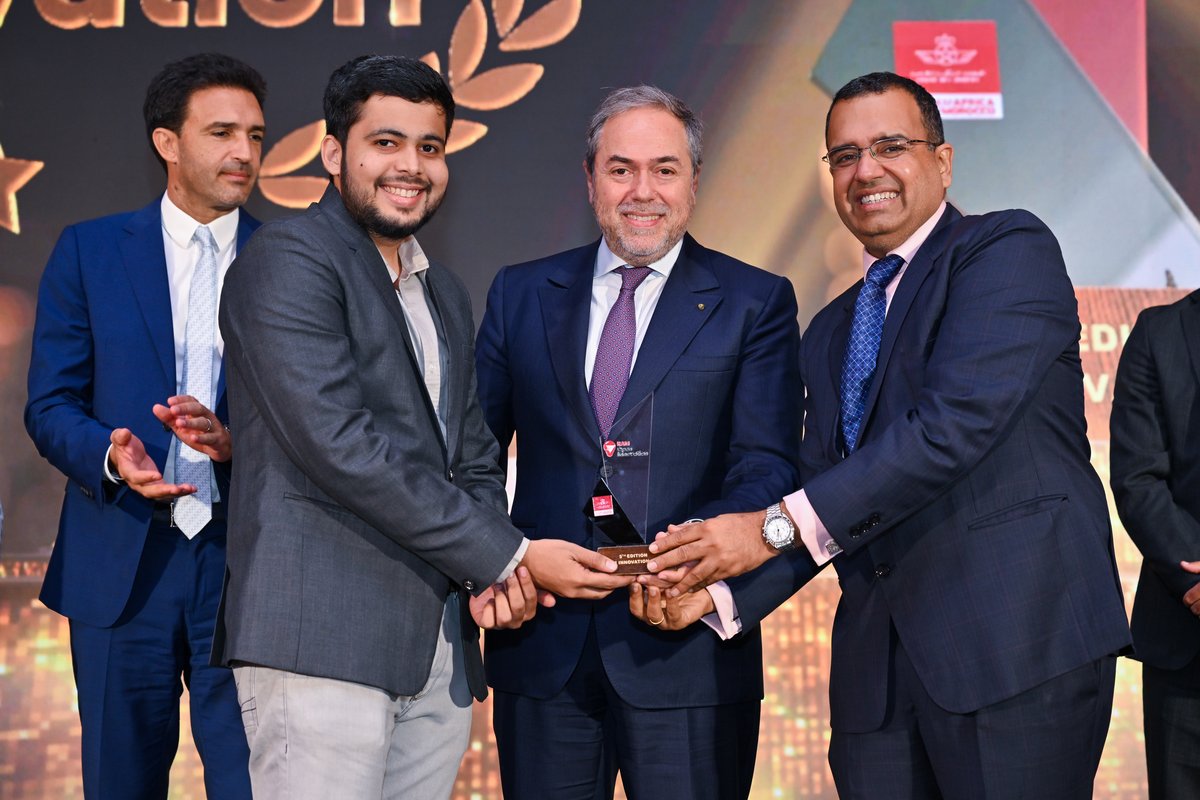
Some milestones recognize what you have already built. Others tell you where you may be going next. On 25 September 2026, 22North won at the 5th Edition of the Royal Air Maroc Open Innovation Program, and it was both.
We are proud of the First Winner trophy, but what matters more is what it recognizes: a way of thinking about passenger operations that Royal Air Maroc’s teams tested, challenged and chose to back.
Royal Air Maroc Open Innovation Program:
Built around real problems
The Royal Air Maroc Open Innovation Program is not a pitch competition in the usual sense. It is built around real airline business challenges. The bootcamp brought together Open Innovation finalists, internal innovation projects, RAM business teams and customer-experience stakeholders. The goal was to collaborate, test ideas and turn them into tangible proof-of-concept propositions.
That format shaped how we worked. Our founder and CEO, Ujwal Makhija, and our Engineering Lead, Israr Lokhandwala, spent the bootcamp working directly with the RAM Open Innovation team. They did not present to a panel from a distance. They sat with the people who live with these operational realities every day, listened to how disruption plays out for passengers and agents, and refined the proposition alongside them.
It was a collaboration between a global flag carrier and an India-built aviation technology company, and it showed how quickly good ideas can move when both sides treat the problem as shared. The speed of that exchange impressed us. RAM’s teams were open, direct and quick to give feedback. That is what innovation and agility look like in practice, and we are grateful to the RAM Open Innovation team for making room for it.
The problem we chose to solve
Air travel has become increasingly digital, but the passenger experience can still feel surprisingly fragmented. A boarding pass sits in one channel, a gate update arrives in another, and baggage information comes from a third system. During disruption, a passenger may receive a notification and still have to visit a website, call the contact centre or find a member of airport staff to resolve the problem.
From the airline’s perspective, these are different systems and operational processes. From the passenger’s perspective, it is one journey.
The days leading up to our presentation were a reminder of why this matters. Headlines about air traffic control failures and widespread flight disruption in the UK showed again how quickly a technical fault can turn into hundreds of thousands of unsettled travel plans. When disruption hits, the quality of the airline’s response is measured in minutes, and in how many steps a passenger must take to get help.
We chose to focus on irregular operations (IRROPS) because the need is real. When a flight is delayed or cancelled, a large number of passengers need clear information and a path forward, all at the same time. Traditional channels such as email and SMS are often poorly suited to that moment.
One continuous passenger conversation
Our proposition for Royal Air Maroc (RAM) was built around a WhatsApp Passenger Companion, supported by the 22North passenger-operations platform. A passenger connects through a simple QR-based onboarding experience and uses a familiar channel to access the relevant parts of their journey. That can include a digital boarding pass, flight information, gate details, baggage status and proactive operational notifications.
The experience becomes more valuable when something goes wrong. Instead of telling passengers about a disruption and leaving them to work out the next step, the same conversation can support self-service actions. A passenger can view alternatives, accept another flight, request eligible recovery options or escalate to an airline representative.
When human help is needed, the passenger should not have to start over. The context travels with them, and the agent picks up the conversation where the passenger left off. That is the core idea: information, transaction and assistance should form one experience.
At Royal Air Maroc, the experience was designed to work in the languages RAM’s passengers use, including English, French and Arabic. Our demonstration covered the passenger journey from flight status and boarding pass access through to disruption handling and live agent handover.
Working with the systems airlines already have
The passenger interface is only the visible layer. The 22North platform is designed as an orchestration layer across an airline’s existing technology environment. For RAM, the solution was designed around integrations with systems such as the PSS, DCS and AODB, along with the contact-centre and customer-engagement tools the airline already uses.
This matters because digital transformation does not require an airline to rip out the systems that manage bookings, departure control or airport operations. The opportunity is to connect those capabilities more effectively and make the resulting intelligence actionable at the passenger level.
In practice, 22North turns operational events into appropriate passenger journeys. It determines what should happen, when it should happen, through which interaction, and what the passenger should be able to do next.
We will go deeper into the solution and how it works in an upcoming post. For now, the important point is that the work was built to operate within the constraints, business rules and architecture of a real airline, not just in a controlled demo.
What Ujwal had to say
For Ujwal, the win reflects a belief that has guided 22North for years.
“The best passenger experiences don’t come from adding more channels. They come from removing the gaps between them. Winning at Royal Air Maroc, in an environment built around real operational challenges, tells us that airlines are ready to turn disruption into a guided journey, and that innovation moves fastest when airline teams and technology partners build side by side. We are grateful for RAM’s openness, and we are only getting started.”
Ujwal Makhija, Founder & CEO, 22North
A milestone beyond Morocco
There is another dimension to this achievement. Royal Air Maroc connects Morocco with an extensive international network, and Morocco is an important gateway between markets. Rabat is not just another city on the aviation map.
For an India-built aviation technology platform, being recognized through the Royal Air Maroc Open Innovation Program is a significant step in our international journey. We draw on more than 20 years of experience inside airline operations, and we see substantial opportunity across Africa as airlines modernize customer engagement, operations and digital servicing while continuing to work with complex existing technology environments.
We hope this milestone becomes the beginning of many more conversations across the region.
Why this recognition matters to us
Our work sits at the intersection of passenger experience, operations and commercial outcomes. A product in this space has to work in the real world, within an airline’s rules, systems and operational pressures. A good demonstration is not enough.
Winning the Royal Air Maroc Open Innovation Program, an environment designed around real business challenges, is an important validation of the direction we are building in. It tells us that the problems we care about are the ones airlines care about too.
What comes next
Winning the Royal Air Maroc Open Innovation Program is not the finish line. The real objective is to convert innovation into operational value:
- Faster passenger resolution during disruption
- More useful, better-timed communications
- Lower pressure on airline teams
- Better visibility across the journey
- Greater passenger autonomy
That is the work ahead, and we look forward to continuing it with Royal Air Maroc.
Thank you
To everyone at Royal Air Maroc, the RAM Open Innovation team, the mentors, the CX teams, the jury, our fellow finalists, and our colleagues at 22North and Phonon who contributed to this journey: thank you. Your openness, feedback and energy made this possible.
From Vadodara to Rabat, this has been a remarkable milestone. And we are only getting started.