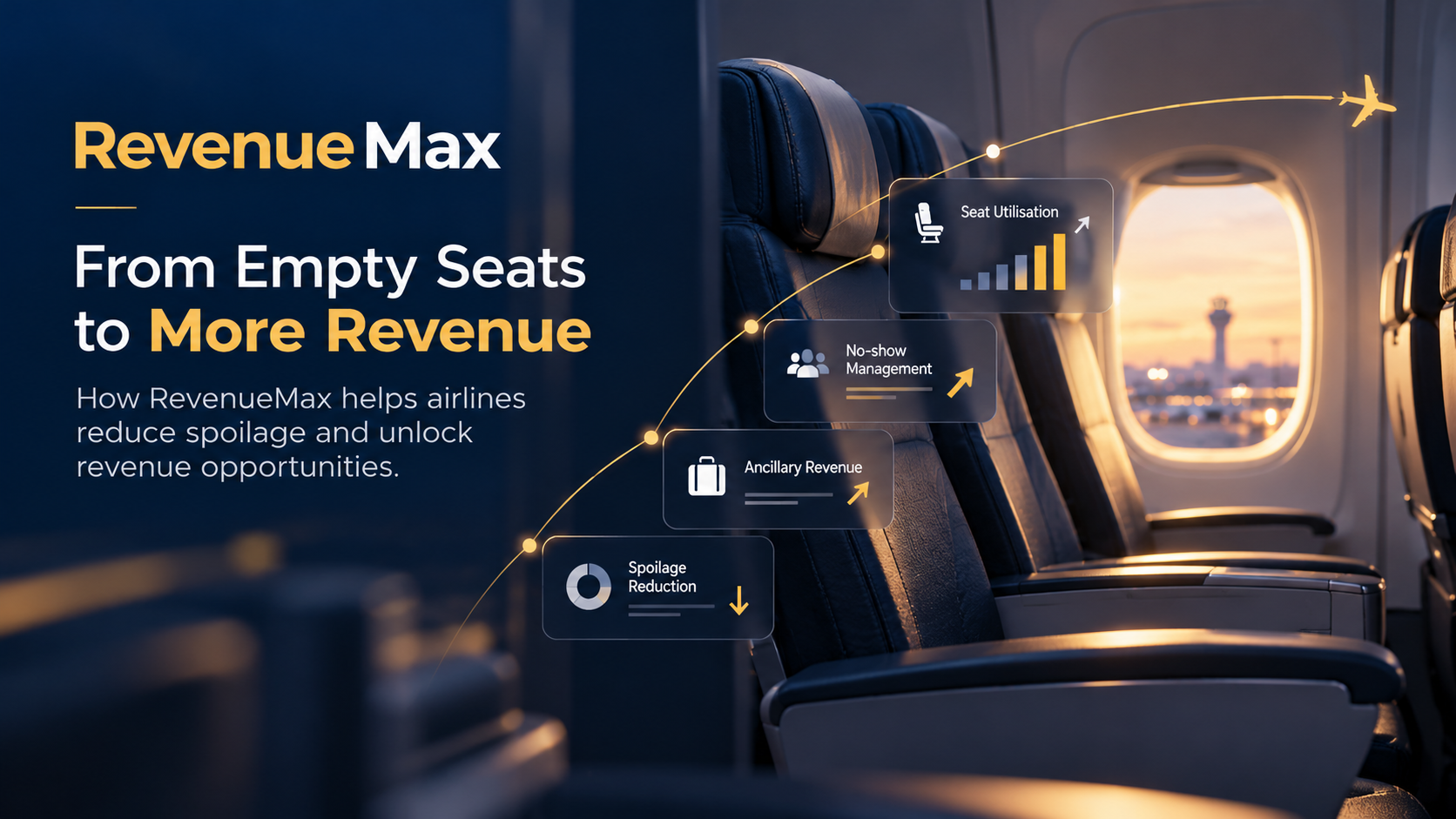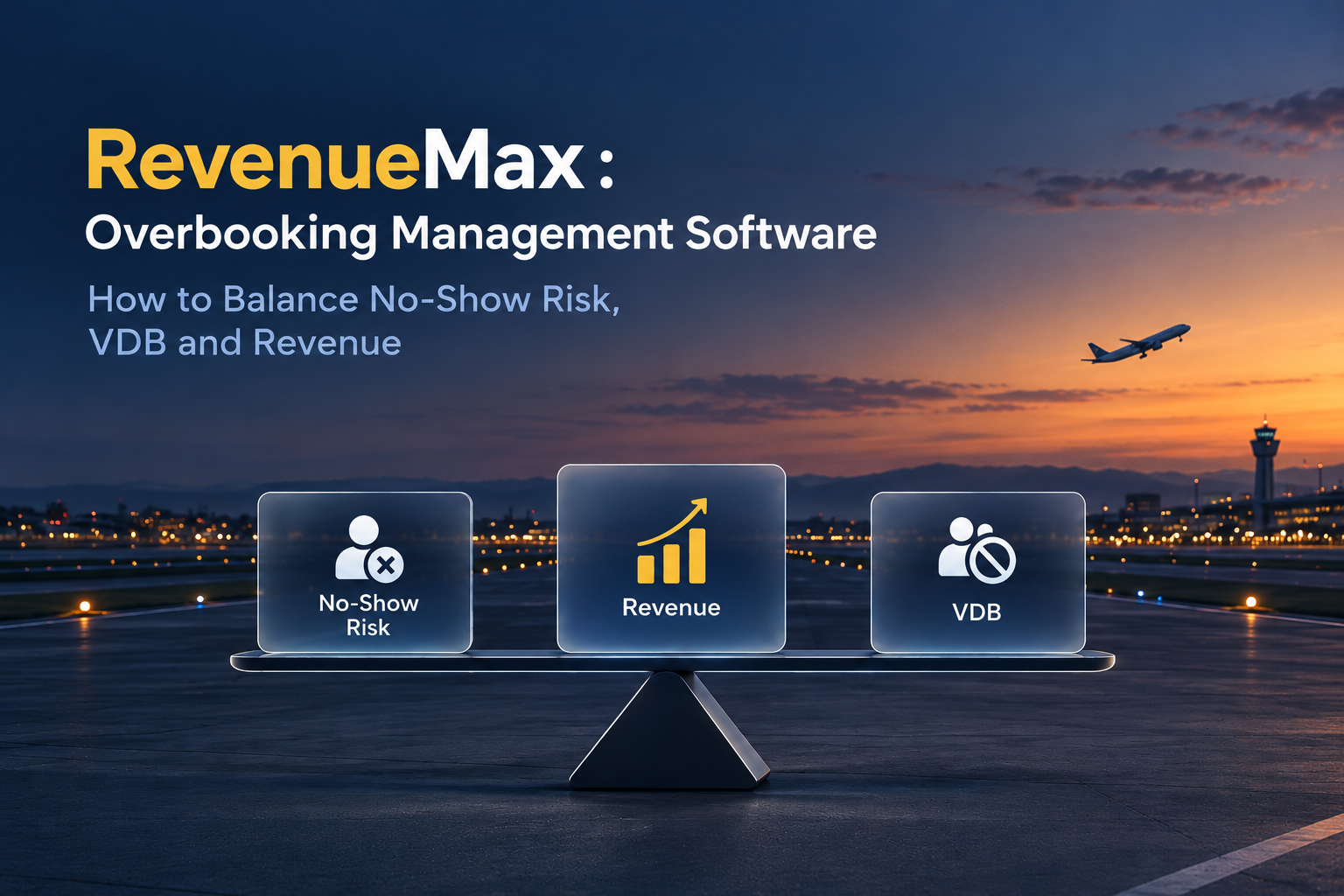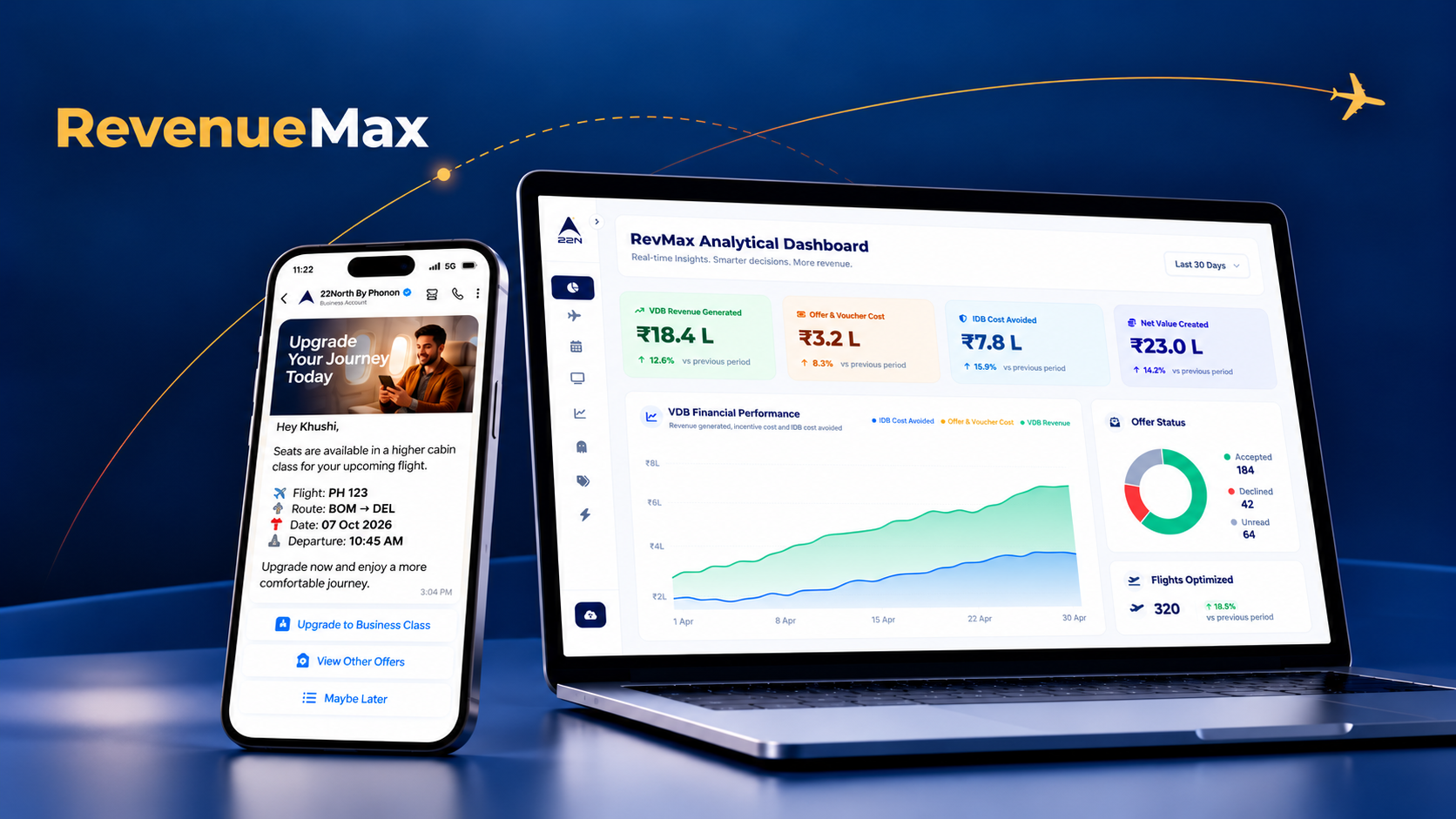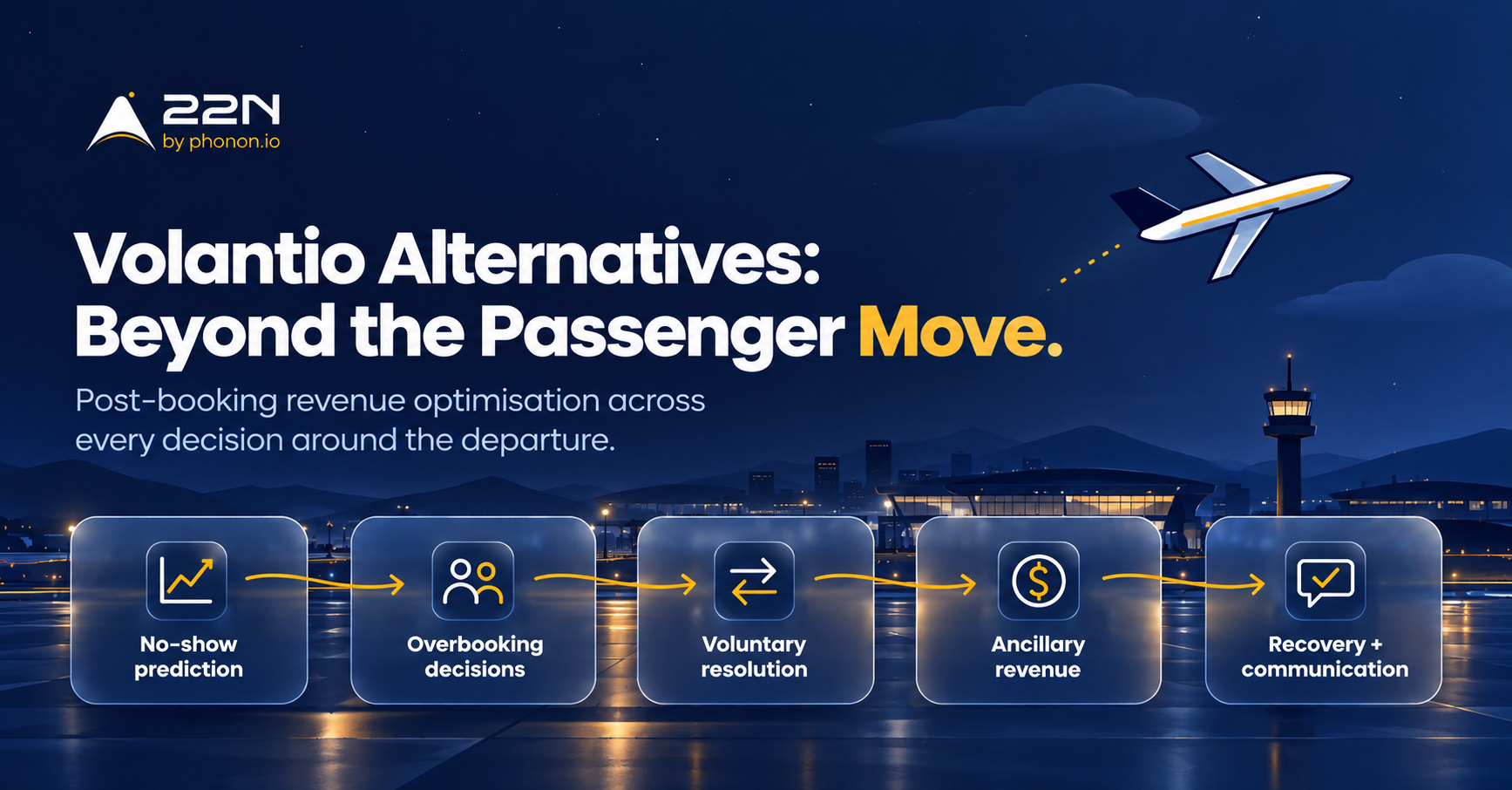
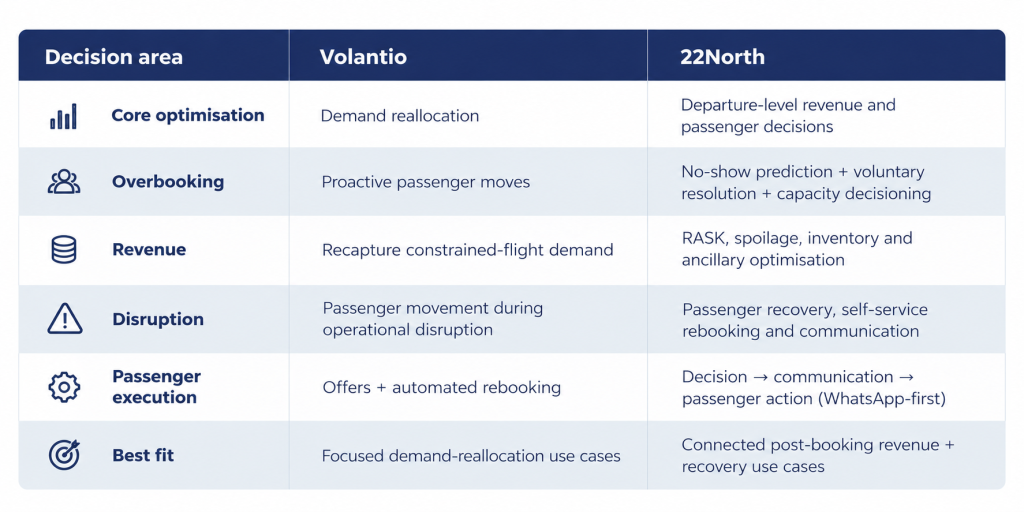
Volantio is built around demand reallocation: finding passengers willing to move off constrained flights and automating the move. 22North takes a broader, departure-level approach covering no-show prediction, overbooking decisions, voluntary resolution, ancillary revenue, disruption recovery and passenger communication. If your airline needs to optimise more than the passenger move itself, then the decisioning scope is the thing to compare.
What is post-booking revenue optimization?
Post-booking revenue optimization is the practice of continuing to manage a flight’s revenue after seats have been sold, up to the moment the boarding door closes. It covers the decisions an airline makes once the original fare is booked: how many passengers will actually show, how many seats can safely be oversold, which passengers might move voluntarily, and what else the airline can sell to the people who do travel.
Revenue management has long treated overbooking and no-show forecasting as core disciplines. Research in the Journal of Revenue and Pricing Management found that a PNR-adjusted, cost-based no-show forecasting method delivered up to 10% revenue gains per available seat-mile over historical-average no-show rates, and estimated overbooking’s share at 15–18% of total revenue management gains over a peak 33-day period. That is why the post-booking window is now a category of its own, and why airlines comparing Volantio alternatives often start with this question: what decisions do we want automated?
Volantio at a glance
Volantio describes itself as a global leader in demand reallocation and says it serves more than 15 airlines, including Southwest, Air Canada, Alaska, Japan Airlines, Qantas and Aeromexico. Its newer platform, Vector, is positioned as an agentic AI. Vector continuously monitors an airline for oversell, demand, operational and revenue opportunities through PSS integrations, and its demand reallocation agent shifts passengers from constrained flights to lower-demand alternatives to capture revenue that would otherwise spill. Its overbooking product works by identifying overbooked and under-filled flights, using ML-driven offers to convince flexible customers to switch, and then moving them automatically through self-service. Coverage of the launch also notes Vector use cases such as opening additional capacity during demand surges and rerouting passengers during weather disruptions.
That is a mature and valuable optimization problem, and a strong fit for airlines whose main goal is moving flexible passengers off constrained flights.
The real distinction: what is the system allowed to decide?
Most airline revenue platform comparisons begin with features. However, a better starting point is decision scope: what is the platform allowed to decide?
A post-booking revenue decision can begin well before anyone decides a passenger should move. Consider a flight ten bookings above capacity. The commercial decision is not “which ten passengers should we move?” Instead, it is a chain of questions:
- How many passengers are actually expected to show?
- How confident are we in that estimate?
- How many voluntary moves are economically justified?
- What will each move cost?
- Could a passenger be monetised through an ancillary or another intervention instead?
- What happens if operational disruption changes the calculation?
The first question matters most. MIT’s airline management course frames overbooking as choosing the maximum bookings to accept so that the combined cost of denied boardings and spoilage is minimised, and notes that the actual no-show rate is highly uncertain. Individual-level prediction improves the inputs. One study found that estimating each passenger’s no-show probability from reservation data, then aggregating, was more accurate than averaging historical no-shows by booking class. Accurate no-show forecasts can raise revenue by reducing both spoiled seats and involuntary denied boardings at the gate.
How 22North approaches the problem
22North positions itself as a Passenger Operations Platform. Its three products are RecoverMax (passenger recovery, rebooking and self-service during disruption), RevenueMax (demand reallocation, spoilage reduction and ancillary sales) and ImpactMax (AI voice and text communication in multiple languages). The platform is WhatsApp-first, integrates with Amadeus Altéa, Navitaire New Skies, Sabre and AIMS, and lists IndiGo, Jazeera Airways, Air India and Air India Express among its airline customers.
The distinguishing idea is that RevenueMax turns no-show predictions and passenger signals into capacity decisions, voluntary resolution and additional revenue opportunities. In that model, moving a passenger is one possible outcome of a wider decision rather than the starting premise. 22North describes the platform as connecting passenger operations with revenue outcomes by unifying communication, decisioning and commerce, and cites a 50+ bps revenue uplift. That is a vendor-reported figure, so ask for evidence relevant to your network.
Volantio vs 22North: the buying question
The useful question isn’t “which platform can move passengers?” Both companies’ public positioning includes passenger movement and automated action.
The more useful question is: how many decisions around the departure do we want one platform to optimise?
If your requirement spans the whole chain, then 22North presents a broader alternative:
no-show prediction → overbooking optimisation → voluntary resolution → inventory recapture → ancillary revenue → disruption recovery → passenger communication
The objective shifts from moving passengers between flights to building a commercial decisioning layer around every departure.
Volantio may be the better fit if:
- Your priority is a focused, proven demand-reallocation programme
- You want a vendor with deep PSS integrations and a large installed base of large network carriers
- Disruption recovery and passenger messaging are handled by other systems
22North may be the better fit if:
- You want no-show prediction, voluntary resolution and ancillary decisions connected
- You want disruption recovery and passenger communication in the same platform
- Your passengers are reachable and transacting on WhatsApp, as in India, MENA and APAC markets
Why voluntary resolution deserves its own line item
Voluntary resolution is a revenue lever and a customer-experience lever, not just a compliance step. A GAO review of U.S. DOT data found that combined voluntary and involuntary denied boardings were under 1% of actual boardings, and that in 2018 about 43 of every 100,000 boardings were voluntary. The scale is small, but the cost per incident is not. Academic work on voluntary overbooking finds considerable mutual benefit for airlines and passengers when customers are invited to state what compensation they would accept. A platform that predicts how many seats are really at risk can reduce unnecessary compensation and still protect against gate-time denied boardings.
FAQ: Volantio alternatives and post-booking revenue optimisation
Is 22North an alternative to Volantio?
Yes, where the requirement includes airline overbooking management, passenger flexibility and post-booking revenue optimisation. Scope differs: Volantio publicly emphasises demand reallocation, while 22North combines revenue optimisation, disruption recovery and passenger communication in a broader Passenger Operations Platform.
What is the main difference between Volantio and 22North?
Optimisation scope. Volantio’s public proposition centres on reallocating demand between flights. 22North treats the passenger move as one possible outcome of a departure-level decision involving no-show probability, inventory, revenue, recovery and passenger context.
Does 22North replace an airline revenue management system?
Not necessarily. It is better understood as extending revenue optimization into the post-booking period, where passenger behaviour, expected show-up, available capacity and operational conditions create new decisions after the fare is sold.
Can 22North support airline overbooking optimisation?
22North positions RevenueMax around no-show prediction, capacity decisions and voluntary resolution, so airlines can act on expected show-up rather than booking volume alone.
What should an airline ask any post-booking vendor?
Ask what decisions the platform makes versus recommends, how no-show confidence is expressed, how compensation is set, which PSS integrations are live, which channels reach passengers, and how results are measured (for example RASK, spoilage and denied-boarding rate).