Why the Future of Aviation CX Is Decision Orchestration
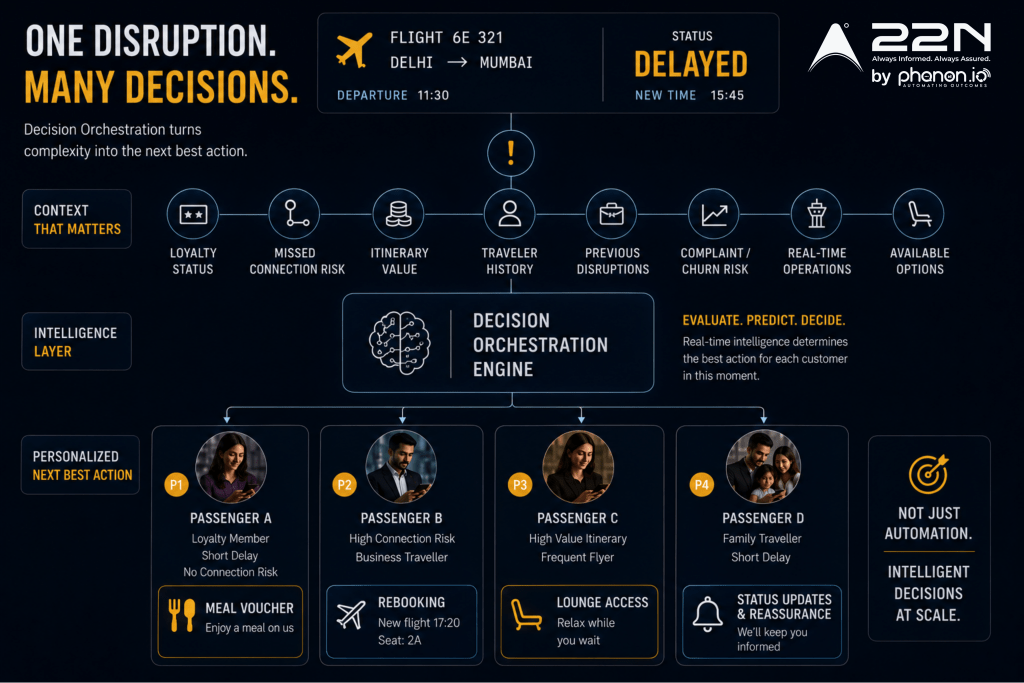
When a flight is delayed, one question quietly determines everything that follows: Who gets the meal voucher? At first glance, the answer seems simple. A passenger is delayed. A policy says they qualify. A voucher is issued. But that is not how modern airlines operate. Behind that single action sits a decision-making system evaluating dozens of variables in real time: The voucher is not the decision. It is merely the outcome of a much larger decision process. This is where Decision Orchestration begins. What Is Decision Orchestration? Most organisations think in workflows: Event → Action A flight is delayed. A notification is sent. A flight is cancelled. A rebooking offer is generated. But customer experience is rarely that simple. Modern organisations must continuously answer a more important question: What is the best action for this customer, at this moment, given everything we know right now? Decision Orchestration is the discipline of answering that question at scale. It sits between: Can Decision-Making Be Automated? The answer is yes—but not entirely. Every mature decision engine combines three elements. 1. Rules The non-negotiables. Policies, regulations, compliance requirements, and business guardrails. Rules determine what is allowed. 2. Models The prioritisation layer. Predictive models estimate outcomes such as: Models determine what is likely. 3. Human Governance The policy layer. Leaders decide: Humans determine what is important. The simplest way to think about it: Rules define the guardrails. Models define the priorities. Humans define the policy. The Shift from Reactive to Predictive Historically, organisations reacted to events. Predictive orchestration changes the model. Instead of reacting to outcomes, systems anticipate them. A disruption engine can identify passengers likely to miss connections before they do. A recovery engine can predict who is most at risk of dissatisfaction. A compensation engine can determine where intervention will create the greatest operational and commercial impact. The result is a shift from reactive service to proactive experience management. Decision Science Is Becoming a Competitive Advantage Why do some airlines recover from disruption more effectively than others? Why do some brands feel personalised while others feel generic? It is the quality of the decisioning layer. The organisations creating sustainable advantage are building systems that continuously evaluate: Signal → Context → Decision → Action → Outcome And then learn from the result. This is decision science applied operationally. How We Think About It at 22North At 22North, we view customer experience orchestration as a decisioning problem before it becomes a communication problem. The Future: Decision Intelligence As AI adoption accelerates, most discussions focus on content generation. But the larger opportunity may be decision generation. Not simply writing the message. Determining whether the message should exist at all. The future of customer experience orchestration will be built on a combination of: The winners will not simply automate customer interactions. They will automate customer decisions. Always Informed. Always Assured.
22North x Optivara: Transforming Airline Disruption Management
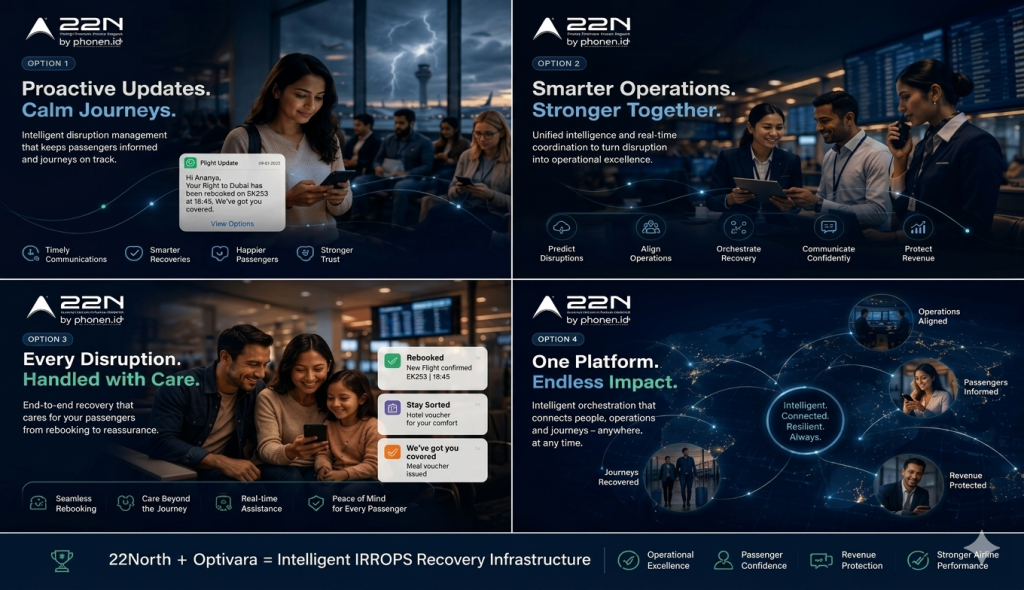
Airline disruptions are inevitable, but poor passenger experiences don’t have to be. Discover how the partnership between 22North by Phonon and Optivara Solutions is transforming disruption recovery through AI-powered decision-making, real-time passenger communication, and intelligent orchestration that improves operational efficiency, customer trust, and airline revenue.
Ancillary Revenue Growth: The Next Frontier for Airline Profitability

Ancillary revenue is becoming a core growth driver for modern airlines, but success depends on delivering the right offer at the right moment. Discover how intelligent journey orchestration with 22North by Phonon helps airlines connect operations, communication, and commerce to boost ancillary sales, improve passenger engagement, and maximize revenue opportunities across every touchpoint.
IRROPs Are Inevitable. Chaos Isn’t.

22North acts as flight disruption communication management engine for airlines. This platform ensures disruptions, while inevitable, are communicated clearly, on time and geared towards providing non-aero revenue opportunity to airlines.
Predictive Communication During Flight Disruptions: How 22North Keeps Passengers Always Informed and Assured

Predictive communication is transforming how airlines manage flight disruptions and passenger experience. Discover how 22North leverages real-time operational data, weather intelligence, and omnichannel messaging to proactively inform passengers, reduce operational pressure, improve loyalty, and unlock new ancillary revenue opportunities.
Best Passenger Communication Platforms for Airlines

Modern airlines need more than basic notifications — they need intelligent, real-time passenger engagement. Explore how platforms like 22North, 15below, and Paximizer are helping airlines improve operational efficiency, personalize communication, manage disruptions, and deliver seamless customer experiences at scale.
Why Airlines Are Moving Beyond SMS for Passenger Communication

Airlines are rapidly moving beyond SMS as passenger expectations shift toward real-time, interactive, and personalized communication. Explore why modern airlines are adopting omnichannel platforms like 22North by Phonon to deliver intelligent passenger engagement across WhatsApp, RCS, email, SMS, and more.
Turning IRROPs Into Revenue, Trust, and Loyalty: A New Playbook for Airlines and Airports

IRROPs no longer need to be viewed as unavoidable operational losses. Discover how predictive communication, AI-driven automation, and intelligent orchestration with 22North by Phonon help airlines transform disruptions into opportunities for increased revenue, stronger passenger trust, and long-term loyalty.
Cracking CSAT Score Improvements with 22North

Customer Satisfaction Scores (CSAT) are reshaping the future of aviation by helping airlines and airports improve passenger experience, loyalty, and operational efficiency. Discover how 22North by Phonon helped Jazeera Airways achieve a 108% increase in CSAT survey response rates through intelligent, omnichannel communication powered by WhatsApp and automation.
How Free In-Flight Wi-Fi Is Becoming the New Airline Standard

Free in-flight Wi-Fi is quickly becoming a standard expectation for modern travelers. Discover how airlines can transform onboard connectivity into a powerful driver of customer loyalty, ancillary revenue, and personalized passenger experiences with intelligent automation solutions powered by 22North by Phonon.