
In today’s hyper-connected world, the aviation industry handles billions of passengers annually and generates massive volumes of operational data every minute. Airlines, airports, ground handlers, crew, and ancillary partners must coordinate seamlessly to deliver safety, efficiency, and a world-class travel experience. Leveraging AI-enabled communications, especially over widely adopted messaging platforms like WhatsApp, can transform coordination. This guide explores how AI can make airport–airline communication smarter, faster, and more cost-efficient.
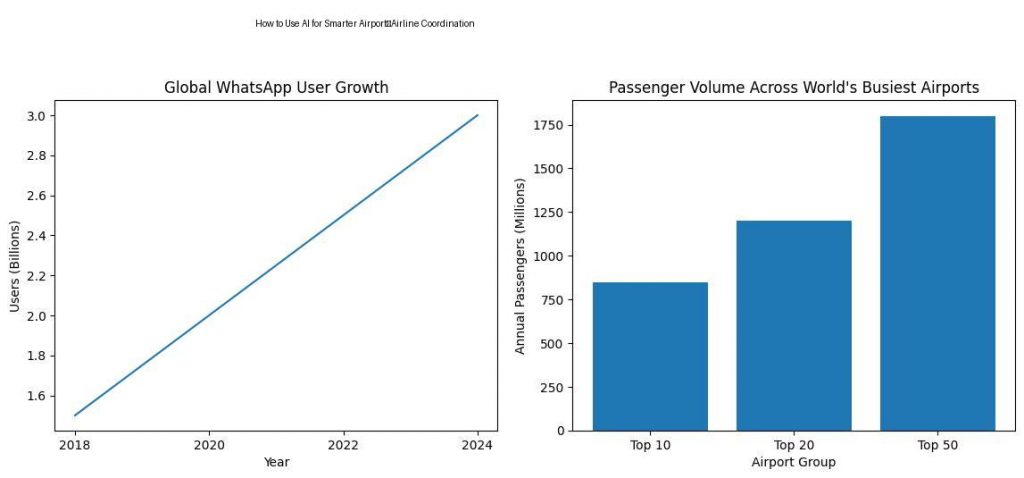
The Scale of the Challenge: Global Aviation by the Numbers
The aviation ecosystem moves billions of passengers and requires complex orchestration across stakeholders:
- – In 2024, global air travel surpassed 9.4 billion passengers which is an increase beyond pre-pandemic levels.
- – The world’s busiest airports handle tens of millions annually. For example, Hartsfield-Jackson Atlanta International Airport served 108 million passengers, followed by Dubai International with 92 million, and Dallas/Fort Worth with nearly 88 million in 2024.
- – In India, Indira Gandhi International Airport in Delhi alone handled over 77 million passengers — ranking ninth globally.
Across these massive numbers, even small inefficiencies in communication or operations can cascade into delays, increased fuel costs, dissatisfied passengers, and stressed crew and ground staff.
WhatsApp: A Ubiquitous Communication Backbone
Before diving into the AI layer, it’s vital to appreciate the scale of platforms like WhatsApp, where much informal and formal coordination already happens:
- – WhatsApp is the world’s most popular mobile messaging app, with over 3 billion monthly active users worldwide as of 2025. Backlinko
- – More than 100 billion messages are sent daily on WhatsApp globally. Backlinko
- – A significant portion of these users are active daily, making it an ideal platform for real-time communication and alerts between teams. Meetanshi – Magento & Shopify Agency
Given this versatility, airports and airlines can leverage WhatsApp not just for passenger updates, but for operational coordination, from crew briefings to ground handling notifications.
Why AI Matters in Airport–Airline Coordination
AI (Artificial Intelligence) is no longer just a buzzword, it’s a practical necessity in aviation operations. Here’s how AI enhances coordination:
1. Real-Time Alerts and Predictive Notifications
Airlines and airports operate within a dynamic environment — flight schedules shift, weather changes, crew availability fluctuates, and technical issues arise.
AI can:
- – Predict potential delays and automatically notify stakeholders via WhatsApp messages.
- – Detect disruptions (e.g., sudden thunderstorms or congestion) and proactively reroute resources.
- – Use historical and real-time data to forecast bottlenecks and surface suggested action plans.
2. Smoother Crew and Ground Handling Coordination
Crew movement (from pilots and cabin staff to maintenance teams) involves scheduling, compliance checks, and logistical updates:
- – AI can integrate crew schedules with flight data to trigger shift adjustments or reminders.
- – WhatsApp alerts can notify teams of last-minute changes or gate assignments.
By automating these notifications, AI reduces manual workload and the risk of human error.
3. Passenger Services and Ancillary Revenue Opportunities
Airports and airlines can leverage AI-driven WhatsApp integration not only for operational communication but also for passenger engagement and upselling:
- – Real-time flight status updates (boarding, delays, gate changes, full emergencies and turnarounds).
- – Promotional offers for lounge access, duty-free discounts, or partner services based on passenger profiles, hyperpersonalized for that passenger cohort.
- – AI chatbots can handle FAQs, ticket changes, or refund queries thus freeing staff to focus on complex issues.
Applying AI to WhatsApp: Practical Use Cases
Here are specific scenarios where AI plus WhatsApp messaging can streamline workflows:
? Flight Delay Predictions
LLMs trained on weather data, aircraft maintenance history, and airport traffic can anticipate probable delays. Automatic WhatsApp updates can go to:
- – Ground operations
- – Flight crew
- – Passenger service teams
- – Affected passengers
This proactive approach reduces waiting times, operational costs, and passenger frustration.
?✈️ Crew Planning and Resource Allocation
AI can analyze:
- – Crew duty hours
- – Rest requirements
- – Flight patterns
Then generate:
- – WhatsApp alerts for duty start times
- – Alerts about compliance adjustments
- – Swap requests for secondary crew
This makes crew coordination more resilient and compliant with regulatory standards.
? Ground Handling Sync
Ground handling involves baggage systems, refueling, catering, and more:
- – AI systems can forecast ground handling windows based on flight schedules.
- – Instant WhatsApp alerts ensure handlers are synchronized before aircraft arrival — minimizing turnaround time.
AI can reduce turnaround delays — a key performance metric for both airlines (schedule integrity) and airports (gate efficiency).
Benefits of AI-Enabled WhatsApp Integration
? Time Savings
Real-time alerts reduce lag between information generation and action by staff — saving minutes that matter in flight operations.
? Cost Efficiency
Minimizing delays and optimizing crew orders and ground services can lead to substantial savings in fuel, staffing overtime, and passenger compensation.
? Better Passenger Experience
Timely updates help reduce anxiety for travelers, improve satisfaction scores, and streamline ancillary revenue opportunities.
? Improved Airport–Airline Relations
Shared dashboards and AI alerts over WhatsApp create one version of the truth for both parties, breaking down silos and enabling a smooth stream of data.
Conclusion: Embracing AI with Messaging Platforms
The aviation sector is scaling like never before, serving billions of people each year and requiring split-second coordination across distributed teams. AI integration with widely adopted messaging apps like WhatsApp isn’t just a convenience but a strategic advantage.
By using AI to generate real-time alerts, predictive insights, and automatic notifications, airports and airlines can ensure smoother operations, happier passengers, and more efficient use of resources. As passenger volumes keep growing, real-time coordination at scale will be the differentiator between operational resilience and costly disruptions.
22North by Phonon sits right at the heart of this essential syncing of operations of airline carriers and airport systems like GHS, BHS, DCS, etc. with a state of the art AI MCP layer built to coordinate between LLMs and reservation systems like Amadeus, Navitaire and Sabre.
Sources:
- https://backlinko.com/whatsapp-users
- https://meetanshi.com/blog/whatsapp-statistics
- https://www.cnbc.com/2025/07/08/here-are-the-top-15-busiest-airports-in-the-world.html
- https://diplomaticwatch.com/here-are-the-15-busiest-airports-in-the-world
- https://indianexpress.com/article/trending/top-10-listing/world-top-10-busiest-airports-2025-delhi-igi-featured-10017001/lite