Irregular Operations (IRROPs) have traditionally been viewed as unavoidable cost centers in aviation—weather disruptions, crew shortages, ATC restrictions, technical faults, or airport congestion that trigger delays, cancellations, and missed connections. The industry’s instinctive response has been reactive: mobilize staff, issue mass alerts, manage queues, and absorb passenger dissatisfaction as collateral damage.
But this mindset is rapidly becoming outdated.
With the right communication infrastructure, IRROPs can be transformed into moments that increase revenue per passenger, strengthen trust, and deepen long-term loyalty. The differentiator is no longer whether disruptions occur, but how early they are anticipated, how coherently they are managed, and how personally passengers are engaged.
The Real Bottleneck: Siloed Systems and Reactive Planning
Most airlines and airports still manage IRROPs across fragmented systems—operations control, crew management, CRM, airport systems, contact centers, and third-party vendors working in isolation. The result is:
- – Delayed recognition of disruption impact
- – Inconsistent passenger messaging across channels
- – Overloaded call centers and ground staff
- – Lost opportunities for ancillary revenue and service recovery
Manual interventions dominate: spreadsheets, phone trees, generic SMS blasts, and reactive announcements once disruption is already visible to passengers.
In an era where passengers expect real-time, personalized communication, this reactive model erodes trust instead of preserving it.
Predictive IRROPs: Acting Before Passengers Feel the Disruption
The next evolution of IRROPs management is predictive, not reactive.
By integrating external intelligence and internal operational data, airlines and airports can anticipate disruption scenarios hours—or even days—in advance. For example, using platforms like Meta, weather signals, regional alerts, and behavioral data can be analyzed to predict:
- – Severe weather patterns affecting departure or arrival stations
- – Likely cascading delays across rotations
- – Passenger volumes at risk of missed connections
- – High-value passengers requiring priority handling
This foresight allows 22North to orchestrate pre-emptive action plans—before queues form, before social media escalations begin, and before passengers feel stranded.
How 22North Enables Predictive IRROPs Management
22North by Phonon acts as a unified communication and orchestration layer, sitting above siloed airline and airport systems.
Instead of waiting for IRROPs to be declared manually, 22North enables:
- – Early Disruption Detection:
Signals from weather intelligence, operational systems, and historical patterns identify potential IRROPs scenarios well in advance. - – Automated Decision Logic:
Rules determine passenger impact by fare class, loyalty tier, connection risk, or special needs—without human bottlenecks. - – Pre-Configured Communication Flows:
Personalized, contextual messages are triggered automatically across channels like WhatsApp, SMS, email, or app notifications. - – Closed-Loop Execution:
Passengers receive not just information, but clear actions—rebooking options, digital vouchers, lounge access, hotel allocations, or compensation eligibility.
This shifts IRROPs handling from crisis response to experience design.
22North Use Case – Jazeera Airways
An example of the use case we built for Jazeera Airways is below:
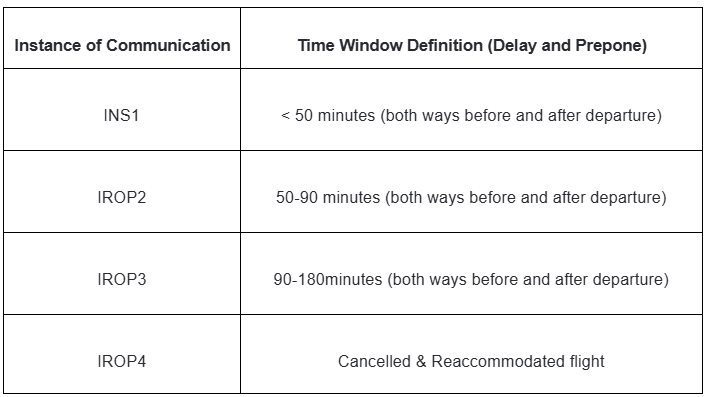
This use case employs both email & WhatsApp to deliver timely notifications to passengers whenever an unscheduled event occurs. This is valid for PNRs which show booking status as “Confirmed” and the boarding status as “Not Boarded”. The information is delivered both by email & WhatsApp so it is impossible to miss. The last instance actually shows the affected passenger a carousel of options over WhatsApp to enable smooth & convenient alternatives to the current flight. When passengers are informed & assured, it reduces pressure on airport counters & call centres.
AIMS and Navitaire are the systems which provide the required information used to trigger the appropriate notifications. 22North utilizes its AI-MCP layer to securely & quickly secure the right parameters for execution.
IRROPs as a Revenue Opportunity
Handled correctly, disruptions unlock incremental revenue rather than destroy it.
During IRROPs, passengers are highly engaged and actively seeking solutions. This creates natural opportunities to:
- – Offer paid seat upgrades on alternative flights
- – Provide discounted lounge access during long delays
- – Sell bundled recovery services (meals, fast-track, Wi-Fi, hotels)
- – Promote partner offers at the airport or destination
Because communication is timely and personalized, these offers feel helpful—not opportunistic. Revenue per passenger increases precisely at the moment traditional systems leak value.
Trust Is Built in Moments of Stress
Passengers rarely judge airlines and airports on routine, on-time journeys alone. Trust is built during disruption.
When passengers are informed before they realize something is wrong—when they receive clear guidance instead of uncertainty—the emotional equation changes. Proactive communication signals competence, empathy, and control.
22North enables airlines and airports to say, “We saw this coming—and we’ve already taken care of it.”
That single perception shift has a lasting impact on brand trust.
Loyalty Is Won Through Consistency, Not Apologies
Apologies without action do little to retain passengers. What builds loyalty is consistent, frictionless recovery.
By automating IRROPs workflows, airlines and airports can ensure that every disruption is handled with the same clarity, speed, and personalization—regardless of scale or time of day. High-value passengers feel recognized, frontline teams feel supported, and operational stress is reduced.
Over time, passengers remember not the delay—but how seamlessly it was handled.
From Manual Firefighting to Intelligent Orchestration
IRROPs are inevitable. Poor experiences are not.
By breaking down silos and shifting from manual intervention to predictive, automated communication, airlines and airports can transform disruptions into moments of differentiation. 22North by Phonon enables this transition—turning IRROPs into opportunities for revenue growth, trust reinforcement, and loyalty acceleration.
In the next era of aviation, the winners will not be those who avoid disruption—but those who master it.